 RouteAll
Oversize Load Sign Requirements By State
Material corrections reviewed October 23, 2026 against Florida’s adopted rule, Georgia DPS, Rhode Island’s active rule, TxDMV and Utah’s current rule effective March 16, 2026. Other state examples retain their earlier source review; confirm current permit conditions.
Check signs, flags and lights against each state’s rules and the issued permit. Several states use a 7-foot by 18-inch banner, but lettering and display triggers vary. Florida requires 12-inch lettering on its load signs. A familiar banner size alone does not establish compliance across a multi-state route.
On This Page
Find Your State’s Sign And Equipment Guide
All 50 state references link the published conditions, distinguish load vehicles from escorts and identify source conflicts or dated material. The comparison below remains a selected-state quick reference.
- Alabama Signs, Flags And Lights
- Alaska Signs, Flags And Lights
- Arizona Signs, Flags And Lights
- Arkansas Signs, Flags And Lights
- California Signs, Flags And Lights
- Colorado Signs, Flags And Lights
- Connecticut Signs, Flags And Lights
- Delaware Signs, Flags And Lights
- Florida Signs, Flags And Lights
- Georgia Signs, Flags And Lights
- Hawaii Signs, Flags And Lights
- Idaho Signs, Flags And Lights
- Illinois Signs, Flags And Lights
- Indiana Signs, Flags And Lights
- Iowa Signs, Flags And Lights
- Kansas Signs, Flags And Lights
- Kentucky Signs, Flags And Lights
- Louisiana Signs, Flags And Lights
- Maine Signs, Flags And Lights
- Maryland Signs, Flags And Lights
- Massachusetts Signs, Flags And Lights
- Michigan Signs, Flags And Lights
- Minnesota Signs, Flags And Lights
- Mississippi Signs, Flags And Lights
- Missouri Signs, Flags And Lights
- Montana Signs, Flags And Lights
- Nebraska Signs, Flags And Lights
- Nevada Signs, Flags And Lights
- New Hampshire Signs, Flags And Lights
- New Jersey Signs, Flags And Lights
- New Mexico Signs, Flags And Lights
- New York Signs, Flags And Lights
- North Carolina Signs, Flags And Lights
- North Dakota Signs, Flags And Lights
- Ohio Signs, Flags And Lights
- Oklahoma Signs, Flags And Lights
- Oregon Signs, Flags And Lights
- Pennsylvania Signs, Flags And Lights
- Rhode Island Signs, Flags And Lights
- South Carolina Signs, Flags And Lights
- South Dakota Signs, Flags And Lights
- Tennessee Signs, Flags And Lights
- Texas Signs, Flags And Lights
- Utah Signs, Flags And Lights
- Vermont Signs, Flags And Lights
- Virginia Signs, Flags And Lights
- Washington Signs, Flags And Lights
- West Virginia Signs, Flags And Lights
- Wisconsin Signs, Flags And Lights
- Wyoming Signs, Flags And Lights
This guide compares 17 state rules and links each one. The oversize load equipment checklist turns them into a shopping list.
Before buying, compare the banner dimensions, letter height, stroke, color, mounting and display trigger for every state on the trip. Check flags and lights separately; a shopping list cannot establish that the equipment meets the permit.
What does an oversize load need?
An oversize load needs three things: a banner on the front and rear, flags on the load's extremities, and warning lights where the state or permit requires them. A pilot car carries its own smaller sign and amber lights. The table shows the common standard for each item and where it goes.
Check the complete specification, including flag placement and the required visibility of signs and lights. A size match alone is insufficient.
| Item | Common standard | Where it goes |
|---|---|---|
| Load banner | Example: 7 ft by 18 in; letters vary, including 12 in in Florida | Front bumper or cab roof, and rear of the load |
| Warning flags | At least 18 in square, red or fluorescent orange | Widest and rearmost points of the load |
| Amber warning lights | Rotating, strobe or flashing, seen from 500 ft (Florida, Oregon) | Above the cab, plus the load where the permit says |
| Rear overhang lights | Red lights at night, seen from 500 ft (California, Texas) | End of a rear overhang of 4 ft or more |
| Pilot car sign | About 5 ft by 10 to 12 in, OVERSIZE LOAD | Roof, or front and rear bumpers |
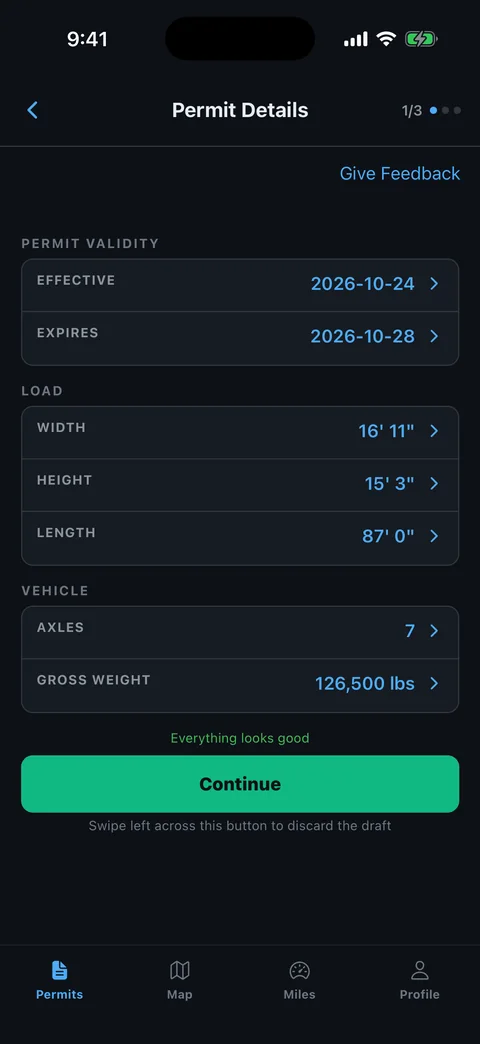
RouteAll reads your permit PDF and guides you turn by turn on the roads the permit names. Check each road against the paper permit before you confirm it. One free trip every month, no card to start.


How big must an oversize load sign be?
Several examples below use a 7-foot by 18-inch sign, but lettering is a separate requirement. Florida’s adopted rule specifies 12-inch black letters with at least a 1.5-inch stroke. Other examples use different dimensions or lettering. Check the applicable state specification before assuming the larger banner satisfies every detail.
The table below shows how far the rules spread, from a 5-foot minimum to an exact 7-foot size.
| State | Sign size | Letters | Source |
|---|---|---|---|
| Arizona | At least 6 ft by 1 ft (drawing in the rule) | At least 6 in, black on yellow | R17-6-303 |
| California | No size set | At least 10 in, 1⅝-in stroke, black on yellow | Caltrans 502.9 |
| Colorado | Exactly 5 ft by 10 in, or exactly 7 ft by 18 in | 8 in (1-in stroke) on the small sign, 10 in (1.41-in stroke) on the large | 2 CCR 601-4 |
| Florida | At least 7 ft by 18 in | 12 in, stroke at least 1.5 in | 14-26.012 |
| Georgia | At least 6 ft by 1 ft | At least 8 in high and 4 in wide | Georgia DPS sign requirements |
| Illinois | About 7 ft by 18 in | About 12 in; 10 in minimum | 92 IAC 554.419 |
| Montana | No size set | At least 8 in | ARM 18.8.510B |
| New Mexico | At least 5 ft by 12 in | Black letters at least 10 inches high on bright yellow | 18.19.8.34 NMAC |
| New York | At least 7 ft by 18 in | At least 10 in, 1.41-in stroke | 17 NYCRR 154-1.13 |
| Ohio | At least 7 ft by 18 in | At least 10 in, 1.41-in stroke | 5501:2-1-04 |
| Oklahoma | At least 5 ft by 14 in | At least 8 in, 1⅛-in stroke | OAC 730:50-5-15 |
| Oregon | 7 ft by 18 in | 10 in, black on highway yellow; reflective at night | OAR 734-082-0037 |
| Pennsylvania | At least 7 ft by 18 in | At least 10 in, 2-in stroke | 67 Pa. Code 179.10 |
| Rhode Island | At least 7 ft by 18 in | At least 10 in, about 1.4-in stroke | 290-RICR-40-00-1.5 |
| Texas | Confirm the load-sign conditions for the actual permit category | Do not substitute the separate escort-vehicle sign specification | TxDMV |
| Utah | 7 ft by 18 in under current R909-2-17 | 10-in black letters, 1⅝-in stroke, yellow background | Current R909-2-17 |
| Washington | At least 7 ft by 18 in | At least 10 in, stroke 1.4 to 1.5 in | WAC 468-38-155 |
A 5-foot sign legal in Oklahoma is too small in at least 10 states here. You must not carry one sign size across state lines without checking.

When do you have to display the sign?
Display triggers vary by state, load and permit category. Florida’s rule lists width, length and height as separate alternatives. Georgia DPS says signs are required on escorts and vehicles transporting permit loads. Do not wait for a load to exceed every listed dimension before checking the sign requirement.
The table shows each trigger and whether the sign comes down after the move.
| State | Required when | Take it down? | Source |
|---|---|---|---|
| Arizona | 9 ft wide or more | Yes: must not be visible to traffic | R17-6-303 |
| California | Over 8 ft 6 in wide, 80 ft long, or 10 ft of overhang | Yes, removed or covered (CVC 35783.5) | Caltrans 502.9 |
| Colorado | Any over-legal load, except overweight-only loads and longer combination vehicles | Not stated | 2 CCR 601-4 |
| Florida | Over 10 ft wide, 80 ft long or 14 ft 6 in high | Not stated | 14-26.012 |
| Georgia | Georgia DPS directs signs on escorts and vehicles transporting permit loads | Yes, removed | Georgia DPS sign requirements |
| Illinois | Over 10 ft wide, 14 ft 6 in high or 75 ft long | Not stated | 92 IAC 554.419 |
| Montana | Over 10 ft wide | Yes, removed | ARM 18.8.510B |
| New Mexico | Every oversize vehicle, combination or load | Not stated | 18.19.8.34 NMAC |
| New York | Over legal width, or over 65 ft long | Not stated | 17 NYCRR 154-1.8 |
| Ohio | Over legal length, 10 ft wide or more, or over 14 ft 6 in high | Not stated | 5501:2-1-04 |
| Oklahoma | Every permitted oversize move | Yes: must not show on a legal vehicle | OAC 730:50-5-15 |
| Oregon | Oversize or overlength vehicles and loads | Yes, removed or retracted | OAR 734-082-0037 |
| Pennsylvania | Every permitted oversize vehicle, unless the permit says otherwise | Yes, removed or covered | 67 Pa. Code 179.10 |
| Rhode Island | Nondivisible-load permit moves | Yes, removed or covered after delivery | 290-RICR-40-00-1.5 |
| Texas | No load-vehicle rule found; check the permit | Escort signs: yes | 43 TAC 219.11 |
| Utah | Non-divisible oversize loads over 10 ft wide OR 14 ft 6 in high OR 105 ft long; LCV exception | Yes: covered, removed or face down | Current R909-2-17 |
| Washington | When the special permit requires it | Yes, removed or retracted | WAC 468-38-155 |
A list joined by “and” is not a safe basis for deciding that no sign is needed unless all dimensions are exceeded. Use the current agency instructions and issued conditions; resolve an unclear trigger with the permit office before movement.
Your permit states which condition applies, so follow the permit. On a Texas permit the conditions sit in the pages after page one; how to read a TxDMV oversize permit shows where.
Width is the trigger that matters most. The oversize load width limits by state guide lists where legal width ends.
Where do the signs go?
One sign goes on the front of the truck, on the bumper or the cab roof. The other goes on the rear of the load or the towed unit. Signs must stay clean and level, and must not cover lights or license plates. Several states add height and visibility rules.
- New York: 2 to 5 feet above the road, readable from 400 feet behind. Night moves need high-intensity reflective sheeting.
- Utah: current R909-2-17 places the sign’s bottom edge no more than 5 feet above the road if possible, with the rear sign as far back as feasible and unobstructed.
- California: at least 18 inches above the road, visible from straight ahead and 45 degrees to each side.
- Florida: if one sign is on the roof, the other goes at the rear of the load or towed unit.
- Arizona: parallel to the road and readable left to right, from the front and the rear.
- Oregon: mounted level, and kept clear of the registration plates.
When can the sign say WIDE LOAD instead?
OVERSIZE LOAD is the standard wording, and it is the only wording Pennsylvania allows. Oregon allows WIDE LOAD on an overwidth load under 80 feet long. Colorado allows Wide Load, Long Load or Oversize Load, whichever fits. California requires LONG LOAD over 100 feet.
- Oregon: LONG LOAD when the load is not overwidth but the vehicle and overhang pass 80 feet.
- California: the sign reads OVERSIZE. WIDE LOAD, OVERSIZE LOAD or EXCESSIVE REAR OVERHANG may replace it.
- Texas escorts: OVERSIZE LOAD or WIDE LOAD.
- Georgia: DPS’s current equipment page specifies OVERSIZE LOAD, with black letters on yellow or orange; confirm the wording required for the actual permit.
OVERSIZE LOAD is the safe choice for most moves.
What size are oversize load flags?
Flags must be at least 18 inches square and red or fluorescent orange, under federal rule 49 CFR 393.87. They mark the widest and rearmost points of the load. The federal trigger is a load that sticks out more than 4 inches past either side, or more than 4 feet past the rear.
- One flag goes on a projection 2 feet wide or less. Two flags go on a wider one.
- Four corners of every overwidth load are flagged in Florida and Ohio. Georgia flags the corners front and rear.
- Utah flags: current R909-2-17 requires red or orange extremity flags for a non-divisible load over 10 feet wide, or front overhang over 3 feet, or rear overhang over 4 feet; LCVs are excepted.
- Oregon flags must be red in daylight, with the holder no more than 3 inches past the load.
- Texas lists 12-inch red flags. An 18-inch flag meets both the Texas and the federal size.
- Clean flags are required in Florida, Ohio, Oregon and Utah. Utah bans torn or faded flags.
Where 49 CFR 393.87 applies, its warning flags must be at least 18 inches square. State requirements also determine placement, condition and display triggers; meeting the federal size does not settle those questions.
When do you need amber warning lights?
Amber warning lights are set by each state and the permit. Florida requires class 2 amber rotating, strobe or flashing lights over 10 feet wide or 80 feet long. Oregon requires them over 10 feet wide on two-lane highways, and over 12 feet on four-lane highways. Both states require 500 feet of visibility.
Montana is the one state here that ties the lights to the sign.
"On the power unit, flashing amber lights, a minimum of five inches in diameter, 50 candlepower, 60 to 90 flashes per minute, shall be mounted at each end of the oversize load sign and visible 360 degrees." — ARM 18.8.510B(1)(b). Verified September 25, 2026.
Night travel adds its own rules.
- Overhang lights have separate triggers; check the actual projection and the applicable vehicle and permit rules.
- Utah lighting: current R909-2-14 includes additional non-daylight marker and overhang lighting, low beams, and any added issued safety conditions.
- Reflective signs are required at night in Oregon and New York.
- Two pilot cars exempt an Oregon load from the warning-light rule.
- Florida night moves need warning lights that show the shape and size of the load.
Many states limit oversize moves to daylight.
The travel time and curfew restrictions by state guide lists the hours.
Flags and lights by state
Flag size is close to uniform at 18 inches, but light rules differ in almost every state. The table shows the flag and light rule in each state RouteAll covers.
| State | Flags | Warning lights | Source |
|---|---|---|---|
| Arizona | At least 18 in, red or fluorescent orange | Night safety lighting when the load sticks out over 4 in to the side or 4 ft front or rear | R17-6-302, -304 |
| California | At least 18 in, red or fluorescent orange, on a rear overhang of 4 ft or more | Two red lights on that overhang at night, seen from 500 ft; amber lights per the permit | Caltrans (CVC 24604) |
| Florida | At least 18 in, on all four corners and on overhangs | Class 2 amber over 10 ft wide or 80 ft long, seen from 500 ft | 14-26.012 |
| Georgia | 18-in red, at the corners front and rear | Not set in the sign rule; check the permit | Georgia DPS sign requirements |
| New Mexico | At least 18 in, red or fluorescent orange, at all times | Amber lights on the power unit and rear for continuous movement; check the permit | 18.19.8 NMAC |
| Ohio | At least 18 in, red or orange, all four corners | Flashing amber beacons when the permit requires them | 5501:2-1-04 |
| Oregon | At least 18-in red on overwidth extremities in daylight | Amber above the cab over 10 ft wide (two-lane) or 12 ft (four-lane) | OAR 734-082-0036 |
| Pennsylvania | At least 18 in, red or fluorescent orange | Headlamps on with a pilot car; extra lighting in urbanized areas from 3 a.m. to sunrise | 67 Pa. Code 179.10 |
| Texas | 12-in red at the extremities | Two red lamps on a rear overhang over 4 ft; amber beacon in overlength convoys | TxDMV |
| Utah | Non-divisible: red/orange extremity flags over 10 ft wide, or front overhang over 3 ft, or rear overhang over 4 ft; LCV exception | Current R909-2-14: additional non-daylight marker/overhang lighting; check the permit | Current R909-2-17 |
Each state guide has the full permit rules. In the West: Arizona oversize rules, California oversize rules, New Mexico oversize rules, Oregon oversize rules, Texas oversize rules and Utah oversize rules. In the East: Florida oversize rules, Georgia oversize rules, Ohio oversize rules and Pennsylvania oversize rules.
What signs and lights does a pilot car need?
Pilot car signs are smaller than load signs, usually 5 feet long and 10 to 12 inches high. They read OVERSIZE LOAD in black on yellow, on the roof or the bumpers. Pilot cars also run amber warning lights. Florida and Oregon require those lights to be visible from 500 feet.
- Pennsylvania, New York and Ohio: 5 feet by 12 inches with 8-inch letters. Pennsylvania adds one or two amber lights.
- Oregon: 5 feet by 10 inches above the roofline, amber lights above the cab, and two 18-inch red flags.
- Texas: 5 to 7 feet long and 12 to 18 inches high. Lights are two flashing amber, one 8-inch amber beacon, or blue and amber.
- California: an OVERSIZE sign of at least 440 square inches, 6-inch letters, at least 48 inches up.
- New Mexico: 5 feet by 12 inches, two amber lights on the roof, and two red or orange flags.
- Florida: 10-inch letters, two 18-inch flags on the roof rack, and two spare 7-foot load signs.
Texas and Oregon escorts must not show the sign at other times.
The pilot car requirements by state guide covers when an escort is required.
Use This Check In RouteAll
Use RouteAll’s shared route to brief the crew before the move, then compare each jurisdiction’s marking conditions with the equipment on the vehicles. A route link does not replace sign or lighting checks.
Before you roll
Prepare a state-by-state equipment check before buying or departing. Match every required specification, not just the banner’s overall dimensions. In particular, check Florida’s 12-inch load-sign letters and keep load-vehicle and escort-vehicle equipment separate.
Lights change most at state lines, so read the permit for each state before you cross.
Common questions
What size is an oversize load banner?
There is no universal banner specification in this guide. Several examples use 7 feet by 18 inches, but letter height, stroke, mounting and display conditions differ. Florida requires 12-inch load-sign letters, so a banner with 10-inch letters is insufficient there. Check every state’s current rule and permit.
What are the oversize load banner requirements?
The banner reads OVERSIZE LOAD in black letters on a yellow background. One goes on the front bumper or cab roof, and one goes on the rear of the load. Ten of the 17 states checked require it removed or hidden when you run legal.
What flags and lights does an oversize load need?
Where the federal projecting-load rule applies, use red or fluorescent-orange flags at least 18 inches square. Check state placement rules and the permit as well. Lighting requirements vary with dimensions, overhang and travel conditions; meeting a flag-size rule does not establish that the required lamps or warning lights are present.
What oversize load accessories do I need?
Build the equipment list from the actual permit and each state’s current rules. Check the number, dimensions, lettering, placement and condition of signs and flags, plus light color, visibility and overhang requirements. A generic banner-and-beacon kit does not establish compliance for every load.
Do I take the sign down when I run legal?
In 10 of the 17 states checked, yes. Arizona, California, Georgia, Montana, Oklahoma, Oregon, Pennsylvania, Rhode Island, Utah and Washington require the sign removed, covered, retracted or hidden. Oklahoma forbids showing the sign on a legal vehicle at all.
Is there a federal oversize load sign rule?
No. The federal rule, 49 CFR 393.87, covers warning flags only. Flags must be at least 18 inches square, red or orange fluorescent. Sign size, letters and triggers are set by each state and your permit.
Further reading
Sources
- Federal flags, 49 CFR 393.87, warning flags on projecting loads.
- Arizona, R17-6-302 flags, R17-6-303 signs, R17-6-304 lighting, and the official rule text.
- California, Caltrans Transportation Permits Manual 502.9, Caltrans overhang rules (Vehicle Code 24604), and Vehicle Code 27904.5 for pilot cars.
- Colorado, 2 CCR 601-4, section 405.7, warning signs.
- Florida, Fla. Admin. Code R. 14-26.012, safety requirements.
- Georgia, R. 672-2-.06 and R. 672-2-.07.
- Illinois, 92 Ill. Admin. Code 554.419.
- Montana, ARM 18.8.510B, signs and lights.
- New Mexico, 18.19.8 NMAC, sections 25, 33, 34 and 88.
- New York, 17 NYCRR 154-1.8 and 154-1.13.
- Ohio, Ohio Admin. Code 5501:2-1-04 and ODOT Form OS-1A.
- Oklahoma, OAC 730:50-5-15.
- Oregon, OAR 734-082-0035 pilot vehicles, 0036 warning lights, and 0037 signs and flags.
- Pennsylvania, 67 Pa. Code 179.10.
- Rhode Island, 290-RICR-40-00-1.5.
- Texas, 43 TAC 219.11 and TxDMV escort and equipment requirements.
- Utah, Utah Admin. Code Current R909-2-17.
- Washington, WAC 468-38-155.
RouteAll reads the permit you provide. It does not issue permits or guarantee compliance, and it does not check your signs, flags or lights. The permit and the issuing state's rules govern every move, and both change, so check them before you roll.