 RouteAll
Utah Oversize Load Requirements: Permits, Escorts, Hours
Updated October 23, 2026 using the current R909-2 rule effective March 16, 2026 and Utah’s published permit-fee statute.
Utah’s ordinary legal dimensions include 8 feet 6 inches in width and 14 feet in height. An oversize movement needs the appropriate permit when it exceeds the limits for its vehicle and load. Escort and travel rules depend on road type, dimensions and daylight. Start with the issued permit, then apply the current rule’s most stringent applicable requirement.
On This Page
What Are Utah’s Ordinary Size And Weight Limits?
R909-2-4 and -5 list the vehicle dimensions and gross/axle-weight rules. For an ordinary vehicle without a special permit, the listed width is 8 feet 6 inches and height is 14 feet. A semitrailer’s listed maximum is 53 feet; other vehicle combinations use different length entries. Do not use a trailer-length number as a universal overall-length limit.
The ordinary weight table lists 80,000 pounds gross, 20,000 on a single axle and 34,000 on a tandem. Tire, axle and bridge-formula requirements still matter, and the rule contains specific exceptions. Check the complete combination instead of treating gross weight as the only weight test.
Which Permit And Fee Apply?
Utah Code 72-7-406 sets the basic oversize fees: $30 for a single trip of no more than 96 continuous hours, $75 for a semiannual permit of no more than 180 continuous days, and $90 for an annual permit of no more than 365 continuous days. Those are category limits; your issued dates can be narrower.
The $60 single-trip oversize-and-overweight fee under subsection 6 applies to the non-divisible category up to 125,000 pounds gross. Heavier or different categories use other provisions and fees. Do not budget $60 for every overweight move.
R909-2-8 generally requires the permit before operating in Utah. Its entry exceptions are directional: northbound I-15 at St. George, westbound I-80 at Echo and eastbound I-80 at Wendover. A permit must be carried in paper or electronic form. The word annual does not authorize any road or configuration you choose; check the category, route and written conditions.
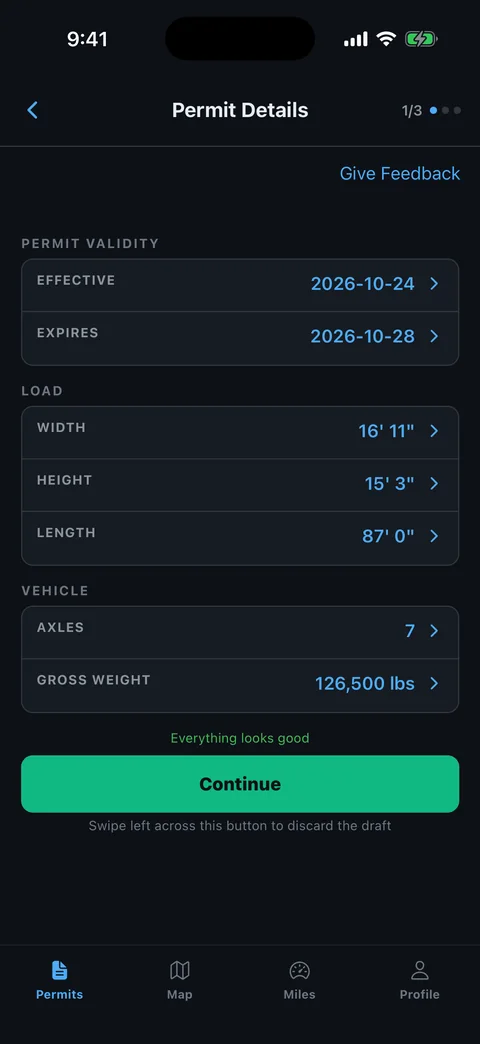
How Do Utah’s Pilot And Police Escort Triggers Work?
R909-2-14, Table 3 applies to non-divisible loads and says to follow the most stringent applicable requirement. The following daylight examples are not an exhaustive escort decision. The division can require additional escorts, and police staffing is determined by the Utah Highway Patrol.
| Condition | Escorts |
|---|---|
| Freeway, daylight: over 14 ft wide or 120 ft long | 1 pilot |
| Secondary highway, daylight: over 12 ft wide or 105 ft long | 1 pilot |
| Freeway, daylight: over 16 ft wide or 16 ft high | 2 pilots |
| Secondary highway, daylight: over 14 ft wide, 120 ft long or 16 ft high | 2 pilots |
| Freeway, daylight: over 20 ft wide, 175 ft long or 17 ft 6 in high | 2 pilots and at least 2 police escorts |
| Secondary highway, daylight: over 17 ft wide, 175 ft long or 17 ft 6 in high | 2 pilots and at least 2 police escorts |
A front or rear overhang greater than 20 feet requires a pilot on the corresponding side. Check overhang separately, even if the width and overall length are below a listed trigger. Read the pilot-car requirements guide for the difference between staffing and operator qualifications.
What Changes For Night Travel, Curfews And Holidays?
The non-daylight columns of Table 3 are separate from the daylight columns. On freeways, a load above 14 feet wide, 105 feet long, 14 feet 6 inches high or 10 feet of overhang is not authorized during non-daylight hours under that table. On secondary highways, the corresponding width ceiling is 12 feet, with the same listed length, height and overhang limits.
Being within those dimensions does not remove nighttime escort and lighting requirements. Table 3 lists a pilot for widths from 12 to 14 feet on a freeway and up to 12 feet on a secondary highway. Any division-authorized exception or additional safety measure must be noted on the permit.
R909-2-12 sets the weekday congestion windows at 6–9 a.m. and 3:30–6 p.m. Mountain time on named highways. Its scope includes specific portions of I-15, I-80, I-84 and SR 68 as well as named counties. Read the dimension wording and full geography with the permit; do not infer an exemption from a shortened summary of the Wasatch Front.
R909-2-13 covers Christmas, New Year’s Day, Memorial Day, Independence Day, Labor Day and Thanksgiving. It also has a special sequence for Monday or Monday-observed holidays, plus possible division restrictions for high-volume days. Check the full date sequence before scheduling the move.
R909-2-11 contains weather restrictions that supersede conflicting provisions. A permit date or a nighttime row does not authorize movement when the applicable weather restriction prohibits it.
Which Signs, Flags And Lights Need A Separate Check?
R909-2-17 requires an OVERSIZE LOAD sign for a non-divisible oversize load exceeding 10 feet in width, 14 feet 6 inches in height or 105 feet in length. The sign is 7 feet by 18 inches, yellow, with 10-inch black letters and a 1⅝-inch stroke. The rule also controls placement, legibility and removal or covering when the vehicle is not in an oversize movement.
Red or orange flags apply to extremities when width exceeds 10 feet or overhang exceeds 3 feet to the front or 4 feet to the rear of the bed/body. Night lighting is addressed separately in R909-2-14, including width markers, overhang lamps and longer-load lighting. Compare the actual equipment with the sign requirements guide; an escort-vehicle sign is a different requirement.
When Does A Larger Move Need Extra Lead Time?
R909-2-16 addresses loads over 17 feet wide on two-lane routes, 20 feet wide on interstates, or 17 feet 6 inches high. The permittee must request authorization online at least two business days ahead. Two business days is not the same as 48 elapsed hours.
The same provision requires responsibility for utility authorizations and clearances, and payment for required certified police escorts. Submit the complete configuration and route to UDOT rather than assuming a size label or an escort count completes approval.
Use This Check In RouteAll
Upload the issued document through RouteAll’s permit-to-GPS workflow, then compare every extracted road with the permit. Keep the travel windows, attachments and escort instructions available alongside the map. RouteAll does not issue permits, authorize exceptions or establish that an extracted route is legally approved.
Before You Roll
Match the loaded configuration to the permit, check its dates and route, and review each applicable Table 3 row. Confirm travel windows, current restrictions, lighting and qualified escort positions. Use the Utah permit-reading guide to keep document interpretation separate from general thresholds.
Common Questions
How much is a Utah oversize permit?
Utah Code 72-7-406 sets a $30 fee for a single-trip oversize permit, valid for no more than 96 continuous hours. The $60 oversize-and-overweight fee under subsection 6 has a gross-weight ceiling of 125,000 pounds; other categories have different fees. Read the category and dates on the issued permit.
When do you need a pilot car in Utah?
For non-divisible loads in daylight, Table 3 of R 909-2-14 requires one pilot above 14 feet wide or 120 feet long on a freeway, or above 12 feet wide or 105 feet long on a secondary highway. Higher dimensions, overhang and nighttime travel can require more escorts or prohibit movement. Apply the most stringent applicable row and the permit conditions.
Can I show my Utah permit on my phone?
Yes. R 909-2-8 allows paper or electronic permits carried in the vehicle. Obtain the permit before operating in Utah, apart from the specific directional port-of-entry exceptions in that section. Keep the permit and its route and conditions available for inspection.
Further Reading
Sources
- Current Utah R909-2, effective March 16, 2026, especially sections 4, 5, 8, 11–14, 16, 17 and 24. Read through the state’s current-rule viewer on October 23, 2026.
- Utah Code 72-7-406, current published permit categories, fees and conditions.
- UDOT rule index. Its older individual links may require using the state’s current-rule search.
Your issued permit and current agency requirements govern the movement. Resolve an unclear restriction or requested exception with UDOT before driving.