 RouteAll
Pennsylvania Oversize Load Requirements: Permits, Escorts
Last verified October 14, 2026 against the Pennsylvania rules linked below.
A Pennsylvania load needs a permit once it is wider than 8 feet 6 inches, taller than 13 feet 6 inches, or past the length and 80,000-pound limits. The Pennsylvania Department of Transportation (PennDOT) issues single-trip permits through APRAS for $46, or $97 over 14 feet wide.
On This Page
Pennsylvania's law now allows moves every day of the week, though its older regulation still reads otherwise. This page covers that and the rest.
What are Pennsylvania's legal size limits?
Pennsylvania allows 8 feet 6 inches wide, 13 feet 6 inches high and 80,000 pounds gross without a permit. A single trailer may be 53 feet and a single vehicle 40 feet.
The table lists each limit from the Vehicle Code.
| Dimension | Legal limit | Source |
|---|---|---|
| Width | 8 feet 6 inches | 75 Pa.C.S. 4921 |
| Height | 13 feet 6 inches | 4922 |
| Length | 53-foot trailer; 40-foot single vehicle | 4923 |
| Weight | 80,000 pounds gross; 20,000 on the steering axle | 4941, 4943 |
How do you get a Pennsylvania oversize permit?
Apply through APRAS, PennDOT's Automated Permit Routing and Analysis System, where account holders get permits around the clock. A single-trip oversize permit costs $46 under 14 feet wide and $97 over. It covers one trip in one direction and expires after 5 authorized weekdays.
| Permit | Fee | Source |
|---|---|---|
| Single trip, under 14 feet wide | $46, plus $0.04 per ton-mile if overweight | PennDOT fee sheet |
| Single trip, over 14 feet wide | $97, plus $0.04 per ton-mile if overweight | PennDOT fee sheet |
| Annual | Only for named uses, such as construction equipment | PennDOT fee sheet |
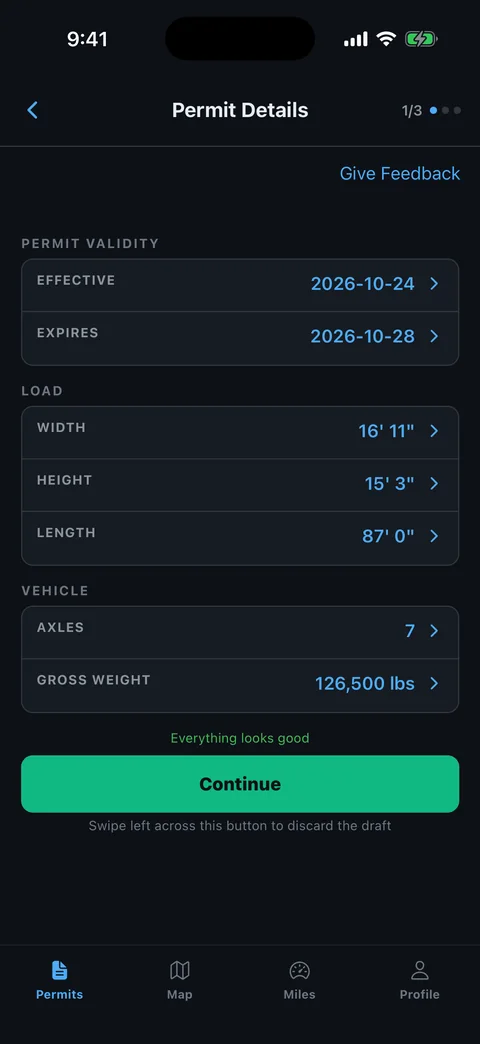
One 3-weekday extension is allowed if you ask before the permit expires. RouteAll reads the permit you upload and drives the route it names, so the roads on the screen are the roads PennDOT approved.
When does Pennsylvania require a pilot car?
Over 13 feet wide, one pilot car: it follows on roads with two or more lanes your way and leads on one-lane roads. Over 90 feet long or 15 feet of rear overhang, one follows. Over 14 feet 6 inches high, a pole car leads by 1,000 to 3,000 feet.
| Load | Pilot cars | Source |
|---|---|---|
| Over 13 feet wide | One; follows on multi-lane, leads on one-lane roads | 179.10(13)(i)(B) |
| Over 90 feet long or 15 feet rear overhang | One, following | 179.10(13)(i)(A) |
| Over 14 feet 6 inches high | Pole car 1,000 to 3,000 feet ahead | 179.10(13)(i)(C) |
| Urbanized area in darkness | Two | 179.10(13)(i)(D) |
| Super load | One certified escort, plus the rules above | 4962(f.6) |
Certification is required only for super-load escorts: age 21 or older, 3 years of experience and an 8-hour course. A certification class from Virginia, Georgia, North Carolina, Colorado or Utah, Florida or Washington replaces the Pennsylvania class; you still apply to PennDOT for the card (PennDOT policy). See pilot car requirements by state.
When can an oversize load move in Pennsylvania?
From sunrise to sunset, every day of the week, under the Vehicle Code. Loads up to 10 feet wide at legal height and length may move around the clock at traffic speed. Holidays, weather and urbanized areas still restrict the window, and your permit can too.
"from sunrise to sunset every day of the week" — 75 Pa.C.S. 4962(f.3). Verified October 14, 2026.
- Old regulation: 67 Pa. Code 179.10(7) still bans Saturday afternoon and Sunday. The 2014 statute overrides it.
- Holidays: no movement on the holiday or the day before: New Year's Day, Memorial Day, Independence Day, Labor Day, Thanksgiving and Christmas (179.10(7)(i)(D)).
- Urbanized areas: only 3 to 7:30 a.m., 9 a.m. to 4 p.m. and 7 p.m. to sunset. Pittsburgh's Fort Pitt, Squirrel Hill and Liberty Tunnels allow only 9 a.m. to 4 p.m.
- Weather: no movement under 1,000 feet of visibility or on unplowed snow or ice (179.10(6)).
- Spacing: stay at least 1,000 feet behind another oversize load going your way (4962(f.4)).
What signs, flags and lights does Pennsylvania require?
Pennsylvania requires a yellow sign at least 7 feet by 18 inches reading only OVERSIZE LOAD, with black letters at least 10 inches high and a 2-inch stroke, front and rear. Flags are red or orange, at least 18 inches square. Remove or cover the sign after delivery.
Pilot cars carry a 5-foot by 1-foot sign with 8-inch letters and one or two amber lights (179.10(13)(ii), (15)). Compare other states in sign requirements by state.
What is a superload in Pennsylvania?
A super load is over 201,000 pounds gross, over 160 feet long or over 16 feet wide (75 Pa.C.S. 3108). It needs a certified escort, and State Police escorts beyond 18 feet wide or 260 feet long. More on thresholds in superload permits.
Use This Check In RouteAll
After receiving the issued permit, use RouteAll’s permit-to-GPS workflow to compare its highway sequence with a reviewable map. Keep local permissions, travel windows and escort instructions available separately. RouteAll does not issue permits or amend the authorized roads.
Before you roll
Check the load against 8 feet 6 inches, 13 feet 6 inches and 80,000 pounds, then buy the permit through APRAS. Plan around the urbanized windows and the day before each holiday. Over 13 feet wide, book a pilot car; over 14 feet 6 inches high, book a pole car and call the utilities 24 hours ahead.
Common questions
How much is a Pennsylvania oversize permit?
A single-trip oversize permit costs $46 under 14 feet wide and $97 over 14 feet wide, under PennDOT's fee sheet effective July 1, 2025. Overweight loads add $0.04 per ton-mile. There is no general annual oversize permit.
Can oversize loads travel on weekends in Pennsylvania?
Yes. 75 Pa.C.S. 4962(f.3), amended in 2014, allows permitted moves from sunrise to sunset every day of the week. The older regulation still bans Saturday afternoon and Sunday, but the statute overrides it. Holidays and your permit can still restrict you.
When do I need a pilot car in Pennsylvania?
Over 13 feet wide, over 90 feet long, or with more than 15 feet of rear overhang, you need one pilot car. Over 14 feet 6 inches high, a pole car must lead the load by 1,000 to 3,000 feet on every highway.
Further reading
Sources
- 75 Pa.C.S. 4921, 4922, 4923, 4941, 4943, 4962 and 3108.
- 67 Pa. Code 179.10.
- PennDOT, hauling permit fees (July 1, 2025), Certified Escort Policy and hauling permit page.
RouteAll reads the permit you provide. It does not issue permits or guarantee compliance. The driver remains responsible for the load. Pennsylvania rules change, and your permit can be stricter than the rule; verify against the permit and the Pennsylvania permit office before every move.