 RouteAll
How to Read a Texas TxDMV Oversize Permit: Every Field Explained
Last verified September 8, 2026 against 43 Texas Administrative Code § 219.11 and the redacted permit shown below.
A Texas TxDMV single-trip permit is a four-page document. Page one carries the dates, the dimensions, the gross weight, the axle table and the origin and destination. The pages after it carry the road-by-road route and the travel rules. Every field is binding, and the travel rules are the field drivers misread most.
This guide walks a real, redacted TxDMV permit one field at a time.
In one minute: the front page of a TxDMV permit tells you when you may move and how big and heavy the permit says you are. It also shows how the weight sits on each axle, and where the trip starts and ends. The road-by-road route and the rules for travel are on the pages after it.
Those rules carry the curfews, the daytime limit and the escort conditions, and they are the part drivers skip.
The permit is issued by the state, but the state does not promise it is right. Whitney once held a Texas permit that routed a 13-foot-wide load down a road posted at 11 feet. The permittee is responsible for the move either way.
Read every field, then check the roads.
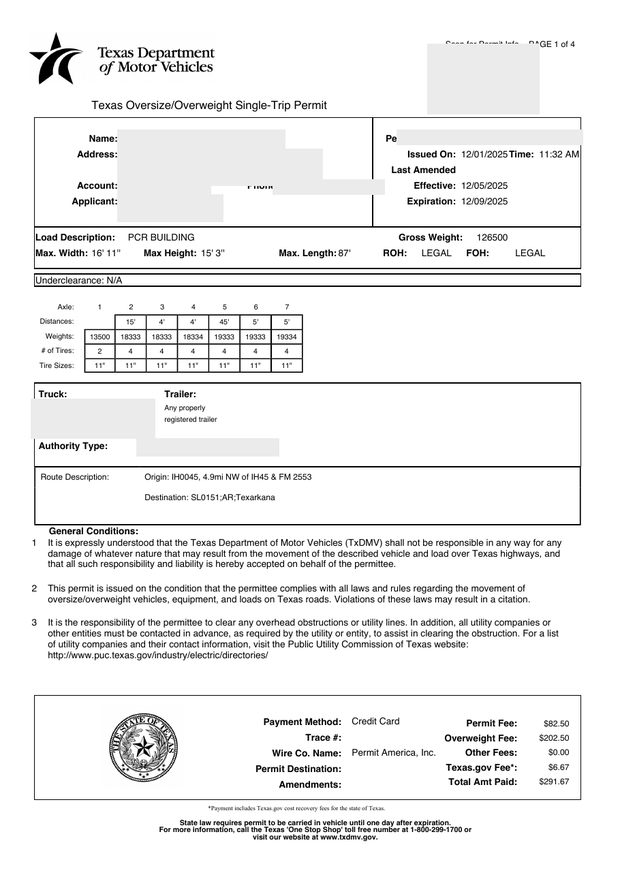
What is on page one of a TxDMV permit?
Page one is the header: who holds the permit, when it is valid, and what the load is. It also carries how big and heavy the load is, how the axles carry it, and where the trip starts and ends. Three general conditions and the fee box sit at the bottom.
Read it top to bottom in that order.
The header fields, in the order they appear:
- Permit number sits top right beside a QR code labeled "Scan for Permit Info". An officer scans it to pull the full record.
- Issued On is the date and time TxDMV created the permit: December 1, 2025 at 11:32 AM on this one.
- Last Amended is blank here. If it shows a date, an earlier version of this permit exists, and only the amended one counts.
- Effective is the first day you may move: December 5, 2025.
- Expiration is the last day: December 9, 2025. Issued on the 1st, good from the 5th to the 9th.
- Name, Address, Account, Applicant, Phone identify the permittee, the company the permit was issued to.
- Authority Type names the operating authority the permittee holds. It is redacted on this sample.
The dates are the first thing to check, because a permit that has not started yet is not a permit.
"State law requires permit to be carried in vehicle until one day after expiration." — footer of the TxDMV single-trip permit shown above.
Which numbers are the load limits?
The load limits are the Max Width, Max Height, Max Length and Gross Weight fields in the block under the header. On this permit they are 16 feet 11 inches wide, 15 feet 3 inches high, 87 feet long and 126,500 pounds. The permit covers a load up to those numbers, and not one inch or one pound over them.
- Load Description says what is being hauled. "PCR BUILDING" here.
- Max. Width 16' 11" is the widest the load may measure. At over 16 feet, Texas requires a front and a rear escort on every road.
- Max. Height 15' 3" is the tallest point. Texas does not require a height pole escort until the load is over 17 feet.
- Max. Length 87' is truck, trailer and load together.
- Gross Weight 126500 is the whole rig in pounds. Texas has no comma here; read it as 126,500.
- ROH and FOH are rear and front overhang. LEGAL means the overhang is within the legal limit.
- Undercarriage is the ground clearance. N/A here: no low-clearance condition applies.
These are maximums, not measurements. If the load measures wider, taller, longer or heavier than the permit says, the permit does not cover the move.
The escort count for these numbers is in Pilot car requirements by state, with the Texas rule linked. Whether a smaller load needs a permit at all is in Do you need an oversize permit? The 4 numbers that decide.
How do you read the axle table?
The axle table has one column per axle, seven on this permit, and four rows. The rows are the distance to the axle before it, the weight on it, the number of tires and the tire size. The seven weights add up to 126,500 pounds, which is the Gross Weight field. If the two numbers disagree, stop and call TxDMV.
Row by row:
- Distances are the gaps between axles, in feet: 15, 4, 4, 45, 5 and 5. The largest gap, 45 feet, is between axles 4 and 5.
- Weights are pounds on each axle: 13,500 on the steer, then 18,333, 18,333, 18,334, 19,333, 19,333 and 19,334.
- # of Tires is 2 on the steer axle and 4 on each of the other six.
- Tire Sizes is 11 inches on all seven.
The overweight fee on this permit, $202.50, is charged against these axle weights. The weights are what an officer checks at the scale.
Where is the route on the permit?
The route starts in the Route Description box on page one, which names only the two ends: an origin and a destination. On this permit the origin is "IH0045, 4.9mi NW of IH45 & FM 2553" and the destination is "SL0151;AR;Texarkana". The road-by-road route follows on the later pages.
Reading the codes:
- IH0045 is Interstate Highway 45. TxDMV writes interstates as IH plus a four-digit number.
- FM 2553 is Farm to Market Road 2553, a state-maintained rural road.
- 4.9mi NW of pins the origin to a point on I-45, 4.9 miles northwest of its junction with FM 2553.
- SL0151 is State Loop 151, and AR;Texarkana means the permit ends at the Arkansas line in Texarkana. Arkansas needs its own permit from there.
The roads listed on the later pages are the only roads the permit covers. What it costs to leave them is in What happens if you leave your permitted route.
Which field do drivers misread most?
Whitney S. Johnson, who runs height pole on the east coast, says the field misread most often is the section on rules and regulations pertaining to travel. It sits on the pages after the front page, and it carries the conditions that change by road and by hour: curfews, the daytime rule, holiday limits and escort positions.
The dimensions on page one do not change on the trip. The travel rules do. Under 43 TAC 219.11 they include:
- Daytime only. A permitted vehicle moves only in daylight, with two exceptions. It may move at night if it is overweight only. It may also move at night on an interstate if it is no wider than 10 feet and no longer than 100 feet, with legal overhang.
- Curfews. The operator "must observe the curfew movement restrictions published by the department," and the permit lists the ones on your route.
- Escorts. Over 14 feet wide: a front escort on two-lane roads, a rear escort on four-lane roads. Over 16 feet wide: front and rear on every road.
- Overhead lines. The permittee, not TxDMV, must contact utility, phone and cable companies when a wire must be raised.
"The operator of a permitted vehicle must observe the curfew movement restrictions published by the department." — 43 Tex. Admin. Code § 219.11(l)(3). Verified September 8, 2026.
Read the travel rules before the dates, because a permit that is valid on Tuesday may still forbid Tuesday at 5 PM in Houston.
Can the permit itself be wrong?
Yes. The state issues the permit, but the state does not guarantee the route fits the load. General Condition 1 on the permit says TxDMV "shall not be responsible in any way for any damage" from the move. Condition 2 makes the permit conditional on your compliance with all laws and rules.
A bad route is your problem.
"I had a permit that routed a 13ft wide load down a road that had a 11ft width restriction."
Whitney S. Johnson, height pole escort
A 13-foot load on an 11-foot road is not a tight squeeze. It is 2 feet of load with nowhere to go, on a route the state printed.
Three things stop it from becoming a strike:
- Read every road on the route pages against posted width and height restrictions before the effective date, not the morning of the move.
- Send the permit to the escort. The pilot car reads the same route and drives it first. A shared route the escort can open free is in Your escort driver shouldn't need a subscription.
- Call TxDMV at 1-800-299-1700 before the start date. The intermediate points of an approved route can be amended before the trip begins.
A permit does not override a posted restriction. You must not take an 11-foot road with a 13-foot load because the permit says so; stop and get the route amended.
RouteAll turns the roads on your permit into navigation and warns you when you leave them. It does not verify that the state routed you correctly. That check is still yours, and the RouteAll home page says so plainly.
What do the fees on the permit mean?
The fee box at the bottom right shows what the permit cost and who paid. On this permit the base permit fee is $82.50, the overweight fee is $202.50, other fees are $0.00, and the Texas.gov fee is $6.67, for a total of $291.67. The overweight fee is the largest line because this load runs 126,500 pounds.
- Payment Method and Trace # record how it was paid. Credit card here.
- Wire Co. Name is the permit service that filed it. Permit America, Inc. filed this one, not the carrier.
- Permit Destination and Amendments are blank on this sample.
- Texas.gov Fee is the state's online cost-recovery charge, noted in the small print under the box.
The fees tell you nothing about where you may drive. They tell you the permit was paid for, which an officer may also check.
Before you roll
Check the dates, then the four load numbers, then the axle sum, then every road on the route pages against the posted limits. The travel rules are the field most drivers skip and the one that most often ends the trip early. RouteAll does not issue permits or guarantee compliance; the permit and the driver do.
If a permit reads wrong in the app, RouteAll support wants the permit number. The other RouteAll driver guides cover the road side of the same trip.
Common questions
How long is a TxDMV single-trip permit valid?
The permit prints its own Effective and Expiration dates, and those two dates are the answer. On the sample permit in this guide the window is 5 days, December 5 to December 9. Texas law requires you to carry the permit in the vehicle until one day after expiration.
What do ROH and FOH mean on a Texas permit?
ROH is rear overhang and FOH is front overhang: how far the load sticks out past the trailer at the back and the front. LEGAL means the overhang is within the legal limit and no extra permit condition applies to it.
Who do I call if the route on my TxDMV permit is wrong?
The permit footer gives the number: the Texas One Stop Shop at 1-800-299-1700. Call before you move. Under 43 TAC 219.11(g), the intermediate points of an approved route can be amended before the start date.
Does RouteAll read TxDMV permits?
Yes. RouteAll reads state-issued oversize and overweight permits as a PDF or a photo, and pulls the permit number, issuing state, dimensions, weights, named roads and travel restrictions. Check every extracted value against the permit before you drive. RouteAll does not issue permits or guarantee compliance.
Further reading
Sources
- Texas, 43 Tex. Admin. Code § 219.11, subsections (g), (k) and (l).
- The redacted TxDMV Oversize/Overweight Single-Trip Permit reproduced above, issued December 1, 2025.
RouteAll reads the permit you provide. It does not issue permits or guarantee compliance. The driver remains responsible for the load. Rules change; verify against the permit and TxDMV before every move.