 RouteAll
Florida Oversize Load Permits: Pilot Cars, Limits, Curfews
Last verified October 14, 2026 against the Florida rules linked below. Permit types and bridge rules verified October 22, 2026.
A Florida load needs an oversize/overweight (OSOW) permit once it is wider than 102 inches, taller than 13 feet 6 inches, or past the length and 80,000-pound limits. The Florida Department of Transportation (FDOT) issues oversize trip permits through its Permit Application System for $5 to $25 by size, valid 10 days; overweight loads add a mileage-based fee.
On This Page
Any load over 8 feet 6 inches wide moves in daytime only. This page covers that and the rest, each linked to the rule.
What are Florida's legal size limits?
Florida allows 102 inches wide, 13 feet 6 inches high and 80,000 pounds gross without a permit. A semitrailer may be 48 feet, or up to 57 feet when the kingpin is 41 feet or less from the rear axle. Front overhang stops at 3 feet.
The table lists each limit with the statute it comes from.
| Dimension | Legal limit | Source |
|---|---|---|
| Width | 102 inches, safety devices excluded | 316.515(1) |
| Height | 13 feet 6 inches | 316.515(2) |
| Semitrailer | 48 feet; up to 57 feet with a kingpin of 41 feet or less | 316.515(3)(b) |
| Front overhang | 3 feet | 316.515(4) |
| Weight | 80,000 pounds gross; 20,000 single axle | 316.535 |
How do you get a Florida OSOW permit?
Apply through FDOT's Permit Application System (PAS), where trip permits up to 16 feet wide, 18 feet high, 150 feet long and 200,000 pounds can be self-issued. The State Permit Office answers at (850) 410-5777. A trip permit lasts 10 days and costs $5, $15 or $25 by size.
Florida law bars an OSOW load from any public road until the permit is issued (316.550(1)).
FDOT permits cover state highways; local roads need a permit from the local authority (14-26.00411(1)).
FDOT's permit office issues these OSOW permit types:
- Trip permit: one haul from origin to destination, valid 10 days, on the route you submit.
- Route Specific Blanket: three months of trips on one defined route.
- Blanket and Vehicle Specific Blanket: annual permits with no fixed route. They must stay off the restricted roads and bridges in the permit's attachments.
PAS shows a paid trip permit on screen to print. Blanket permits arrive by first-class mail, and the original must be in the vehicle (PAS FAQ).
An electronic trip permit is accepted if it is readily available and legible (14-26.012(1)).
Fees step up with each size tier in FDOT's fee table.
| Size tier | Trip permit, 10 days | Blanket, 12 months | Source |
|---|---|---|---|
| Up to 12 feet wide, 13 feet 6 inches high, 85 feet long | $5 | $20 | 14-26.008 |
| Up to 14 feet wide, 14 feet 6 inches high, 95 feet long | $15 | $150 | 14-26.008 |
| Up to 14 feet wide, 18 feet high, 120 feet long | $25 | $250 | 14-26.008 |
| Larger | $25 | Not issued | 14-26.008 |
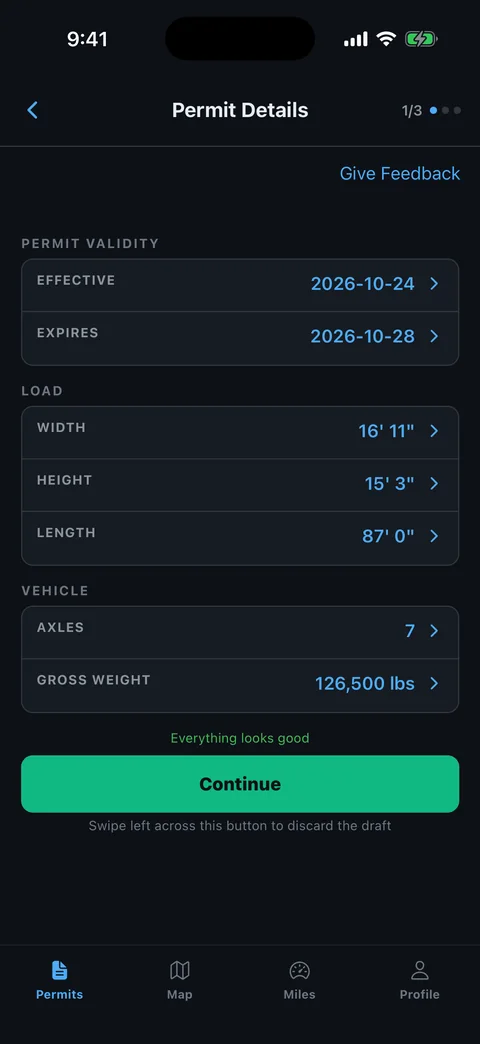
Allow 10 business days for a non-routine permit, one that needs a structural evaluation or an override (14-26.00411(4)). RouteAll reads the permit you upload and drives the route it names, so the roads on the screen are the roads FDOT approved.
Choosing between a trip and a blanket permit is covered in annual vs single-trip oversize permits.
What are Florida's bridge restrictions for OSOW loads?
FDOT checks that the bridges on your route can carry the weight; you check height and width clearance (14-26.00411(5)). A trip permit is valid only on the route it names. A blanket permit may not cross any restricted bridge listed in the permit or its attachments.
"No vehicle may cross any posted bridge when the vehicle exceeds the prescribed limits of the bridge." — Fla. Admin. Code R. 14-26.012(1). Verified October 22, 2026.
- Posted signs for oversize or overweight override the terms of a blanket permit (FDOT blanket conditions).
- Heavy axles get a bridge review. Over 30,000 pounds on any axle or 300,000 pounds gross, send FDOT a vehicle schematic 10 business days ahead (14-26.00411(6)).
- Lower limits can be posted by FDOT or a local authority. They apply where design, deterioration or weather puts a bridge at risk (316.555).
- No overweight loads may use the SR-16 Shands Bridge over the St. Johns River on a blanket permit. US-1 from Florida City to Key West is closed to them too (July 2026 route restrictions).
Blanket overweight loads also follow FDOT's routing maps. Each map's weight chart says its restricted structures are not allowed to be crossed.
| Routing map | Maximum gross | Needs at least | Source |
|---|---|---|---|
| TTT Map 1 | 162,000 pounds | 10 axles, 90-foot outer bridge | FDOT chart |
| TTT Map 2 | 160,000 pounds | 8 axles, 75-foot outer bridge | FDOT chart |
| TTT Map 3 | 199,000 pounds | 11 axles, 100-foot outer bridge | FDOT chart |
Axle-group limits on the same chart apply too.
Outer bridge is the distance from the steering axle to the last axle (14-26.0041(7)). More terms are in the oversize load terms glossary.
FDOT's bridge check covers the permitted route only, so read what happens if you leave your permitted route.
When does Florida require a pilot car?
Florida requires one qualified escort at all times from 12 to 14 feet wide, in front on two-lane roads and behind on four-lane divided roads. From 14 to 16 feet wide, you need two. Height over 14 feet 6 inches adds a front escort with a height pole.
Length and height set their own triggers, listed below.
| Load | Escorts | Source |
|---|---|---|
| Over 12 to 14 feet wide | One; two on narrow lanes, short bridges or busy roads unless four corner lights are fitted | (7)(c) |
| Over 14 to 16 feet wide | Two, front and rear | (7)(d) |
| Over 16 feet wide | Local moves only; law enforcement escorts on most roads | (7)(e) |
| Over 14 feet 6 inches high | One in front with a height pole | (8)(b) |
| Over 95 feet long | One; two over 150 feet off limited-access roads | (9)(b) |
A qualified escort is at least 18, licensed, holds an 8-hour defensive driving course or a commercial driver's license, and has passed an 8-hour flagging course from an FDOT vendor. Florida accepts other states' escorts when their standards are equal or stricter. Full equipment rules are in pilot car requirements by state.
When can an oversize load move in Florida?
Any load over 8 feet 6 inches wide moves in daytime only, half an hour before sunrise to half an hour after sunset. Only a load of legal width that is also no more than 14 feet 6 inches high and 80 feet long may move at all hours. Weekends are closed unless the permit says otherwise.
"No travel is allowed when horizontal visibility is less than 1,000 feet." — Fla. Admin. Code R. 14-26.012(5)(d). Verified October 14, 2026.
- Peak hours: loads over 12 feet wide or 85 feet long stop 7 to 9 a.m. and 4 to 6 p.m. on weekdays. The ban covers Dade, Broward, Palm Beach, Orange, Duval, Hillsborough and Pinellas counties, and nine cities (FDOT conditions).
- Holidays: loads over 10 feet wide, 14 feet 6 inches high or 80 feet long stop on seven days. They are New Year's Day, Memorial Day, Independence Day, Labor Day, Thanksgiving, the day after Thanksgiving and Christmas.
- Weekends: prohibited unless the permit says otherwise (14-26.012(5)(e)).
- South of Florida City: loads over 10 feet wide move only 9 p.m. to 5 a.m. with an escort. Over 12 feet wide, a blanket permit does not allow the move at all.
What signs, flags and lights does Florida require?
Over 10 feet wide, 80 feet long or 14 feet 6 inches high, Florida requires two OVERSIZE LOAD signs. Each is at least 7 feet by 18 inches, with 12-inch black letters on yellow. Class 2 amber warning lights, seen from 500 feet, are required too. Flags at least 18 inches square go on all four corners.
A rear overhang of 4 feet or more takes red flags by day and two red lamps at night (316.228). Other states' sign sizes are in sign requirements by state.
What is a superload in Florida?
Florida does not use the term. FDOT needs a schematic 10 business days ahead when any axle carries over 30,000 pounds or the gross is 300,000 pounds or more. Every oversize move needs a route survey first; over 15 feet high or 16 feet wide, carry the signed survey letter on board (FDOT conditions, July 27, 2026).
Use This Check In RouteAll
After receiving the issued permit, use RouteAll’s permit-to-GPS workflow to compare its highway sequence with a reviewable map. Keep local permissions, travel windows and escort instructions available separately. RouteAll does not issue permits or amend the authorized roads.
Before you roll
Over 8 feet 6 inches wide, plan a daytime move on a weekday unless the permit allows a weekend. Over 12 feet wide, book a qualified escort and route around the peak-hour counties and cities. Watch the visibility: under 1,000 feet, you must exit and park. Overweight, cross only the bridges your permit allows, and never a posted bridge over its limit.
Common questions
How much is a Florida oversize permit?
A 10-day trip permit costs $5 up to 12 feet wide, $15 up to 14 feet wide and $25 above that, under Fla. Admin. Code R. 14-26.008. A 12-month blanket permit costs $20, $150 or $250 by size, and is not issued for the largest tier.
Can oversize loads travel at night in Florida?
Only at legal width. A load no more than 14 feet 6 inches high and 80 feet long may move at all hours if it is no wider than legal. Anything over 8 feet 6 inches wide moves in daytime only, half an hour before sunrise to half an hour after sunset.
Can oversize loads travel on weekends in Florida?
Only if the permit says so. Rule 14-26.012(5)(e) prohibits weekend and holiday moves unless the permit notes otherwise, and FDOT's blanket permit conditions allow all days for many sizes. Read the permit before planning a Saturday run.
What escort do I need in Florida at 13 feet wide?
One qualified escort at all times, in front on two-lane roads and behind on four-lane divided roads. Narrow lanes, short bridges and busy roads require two escorts unless the load carries four corner warning lights.
What is an OSOW permit in Florida?
An OSOW (oversize/overweight) permit is FDOT's special permit for a load over Florida's legal size or weight. Section 316.550 requires it before the load enters a public road. Local roads need the local authority's permit.
Can an overweight load cross a posted bridge in Florida?
Not over the posted limit. Rule 14-26.012(1) bars any vehicle from crossing a posted bridge above its prescribed limits. A blanket permit also bars the restricted bridges in its attachments.
Further reading
Sources
- Florida Statutes 316.515, 316.535, 316.228 and 316.003.
- Florida Statutes 316.550 (special permits) and 316.555 (lowered bridge limits).
- Fla. Admin. Code R. 14-26.0041, 14-26.008, 14-26.00411 and 14-26.012.
- FDOT, Blanket Permit Movement Conditions and Restrictions, revised July 27, 2026.
- FDOT, Blanket Permit Route Restrictions, July 2026.
- FDOT, Weight Restrictions Charts, revised May 22, 2025.
- FDOT, PAS FAQ and the Over-Weight Over-Dimension Permits page.
RouteAll reads the permit you provide. It does not issue permits or guarantee compliance. The driver remains responsible for the load. Florida rules change, and your permit can be stricter than the rule; verify against the permit and the Florida permit office before every move.