 RouteAll
Virginia Oversize Load Permits: Pilot Cars, Limits, Curfews
Last verified November 3, 2026 against the Virginia statutes, regulations and DMV pages linked below.
A Virginia load needs a hauling permit once it is wider than 8 feet 6 inches, taller than 13 feet 6 inches, or past the length and axle-weight limits. The Virginia Department of Motor Vehicles (DMV) issues permits through EZ Haul. A single-trip permit costs $20, plus 30 cents a mile if the load is overweight, and most are valid 13 days.
On This Page
Virginia keeps most permitted loads out of cities and towns from 7 to 9 a.m. and 4 to 6 p.m. This page covers that and the rest, each linked to the rule.
What are Virginia's legal size limits?
Virginia allows 102 inches (8 feet 6 inches) wide, 13 feet 6 inches high and 80,000 pounds gross without a permit. A single truck may be 40 feet long and a combination 65 feet. A tractor-semitrailer may run longer when the semitrailer is no more than 53 feet with a kingpin of 41 feet or less.
The table lists each limit with the statute or DMV page it comes from.
| Dimension | Legal limit | Source |
|---|---|---|
| Width | 102 inches, mirrors excluded | 46.2-1105(A) |
| Height | 13 feet 6 inches, loaded or unloaded | 46.2-1110 |
| Length | 40-foot single vehicle; 65-foot combination; 53-foot semitrailer with a kingpin of 41 feet or less | 46.2-1112 |
| Overhang | 4 feet rear, 3 feet front | Virginia DMV |
| Weight | 80,000 pounds gross by axle spacing; 20,000 single axle; 34,000 tandem | 46.2-1124, 46.2-1126 |
How do you get a Virginia hauling permit?
Register and order through EZ Haul, Virginia DMV's permit system, which replaced VAHPS. It routes the move, lets carriers self-issue some permit types and returns most permits in one day or less. The DMV Hauling Permits office answers at (804) 786-2787.
The permit must be carried in the vehicle it names and shown to any officer who asks (46.2-1139(D)). Cities and towns may issue their own permits for their streets (46.2-1139(A)).
DMV issues these permit types:
- Single trip: one move between two points, valid for most loads for 13 days. It is tied to one vehicle and cannot be transferred (24VAC20-82-50).
- Blanket (annual multi-trip): many moves for one or two years. Request it at least 10 business days ahead (24VAC20-82-80).
- Superload: single-trip or three-month multi-trip authority for loads that need research and analysis.
Fees and the largest load each permit covers come from DMV's hauling page and its size and weight handbook, DMV 109 (July 1, 2024).
| Permit | Fee | Covers up to | Source |
|---|---|---|---|
| Single trip | $20; plus 30 cents a mile if overweight or not licensable in Virginia | 15 feet wide, 15 feet high, 150 feet long; 24,000 single axle, 44,000 tandem | DMV 109 |
| Blanket | $100 for one year, $200 for two; overweight adds $40 mileage and a $360 damage fee a year | 14 feet wide, 14 feet high, 100 feet long | DMV 109 |
| Superload single trip | $30; plus 30 cents a mile and a damage fee by gross weight if overweight | Set by DMV and VDOT review | Virginia DMV |
| Superload multi-trip | $220 for 3 months | One route, case by case | DMV 109 |
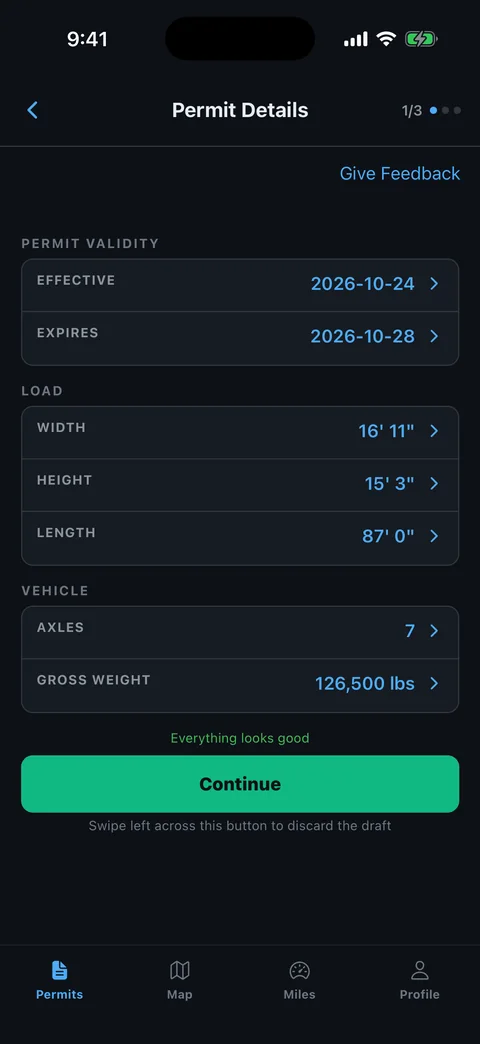
A blanket permit holder must download the VDOT Structure Exclusion List or Locality Document the permit names (Virginia DMV). How to read those attachments is covered in how to read a Virginia oversize permit. RouteAll reads the permit you upload and drives the route it names, so the roads on the screen are the roads DMV approved. It never reroutes you off the permit.
Choosing between a trip and a blanket permit is covered in annual vs single-trip oversize permits.
What are Virginia's bridge and tunnel restrictions?
VDOT or the local authority runs an engineering analysis of the route when safety or bridge capacity calls for it, and DMV will not issue a permit for roads and bridges that cannot carry the load. Blanket permits must avoid the structures on their exclusion list.
"The Commissioner or local authority shall not issue a permit when the Department of Transportation or local authority determines that the roadway and bridges to be traversed cannot sustain a vehicle's size and weight." — Va. Code § 46.2-1139(G). Verified November 3, 2026.
- Low structures: on VDOT roads, a bridge or structure with less than 14 feet of clearance gets two height signs at least 1,500 feet ahead (46.2-1110).
- Tunnels: driving into a tunnel taller than it allows is a misdemeanor with three demerit points and a $1,000 mandatory minimum fine. A repeat offense fines the owner $2,500 (46.2-1110).
- Hampton Roads Bridge-Tunnel: sensors check the height of westbound I-64 traffic. A driver over 13 feet 6 inches may wait for the end of peak traffic so police can stop traffic and let the truck turn back.
- Interstate weight: most overweight permits are not valid on an interstate above 20,000 pounds single axle, 34,000 tandem or 80,000 gross. Irreducible loads are an exception (46.2-1139(B)).
The engineering check covers the permitted route only, so read what happens if you leave your permitted route.
When does Virginia require a pilot car?
Virginia requires escorts once a permitted load is over 12 feet wide: one rear escort on interstates, and one front and one rear on other roads. Over 14 feet 5 inches high, a front escort runs a height pole set 3 inches above the load. Every escort driver must be certified first.
Length and overhang set their own triggers, listed below.
| Load | Interstate | Other roads | Source |
|---|---|---|---|
| Over 12 feet wide | One rear | One front, one rear | (A)(1)-(2) |
| Over 14 feet wide | One front, one rear | Two front, one rear | (A)(3)-(4) |
| Over 16 feet wide | One front, two rear | Two front, two rear | (A)(5)-(6) |
| Over 14 feet 5 inches high | One front with height pole | One front with height pole | (A)(9) |
| Over 90 feet long | None for length alone | One rear | (A)(10) |
| Over 120 feet long | One rear | One rear | (A)(10)-(11) |
| Over 150 feet long | One front, one rear | One front, one rear | (A)(12) |
| Front overhang over 10 feet | One front | One front | (A)(13) |
| Rear overhang over 15 feet | One rear | One rear | (A)(14) |
An off-centered load over 3 feet 6 inches on the passenger side needs a front escort, and over 5 feet a front and a rear escort. Loads over 18 feet wide or 200 feet long are handled case by case, and DMV can change any escort requirement for the route (24VAC20-82-130).
Escort cars carry a two-way radio, a roof light seen from 500 feet and a fire extinguisher of at least 5 pounds (24VAC20-82-120). Credentials and the states Virginia accepts are in Virginia pilot car qualifications; other states are in pilot car requirements by state.
When can an oversize load move in Virginia?
Permitted loads move from sunrise to sunset. Inside city and town limits they stop from 7 to 9 a.m. and 4 to 6 p.m., unless the load is only overweight or only overlength up to 85 feet, rear overhang included. Some superloads may be required to move in darkness.
"Normal times of travel for permitted loads are sunrise to sunset." — 24VAC20-82-110(B). Verified November 3, 2026.
- Holidays: no travel on New Year's Day, Memorial Day, Independence Day, Labor Day, Thanksgiving or Christmas. Permits stop being valid at noon on the weekday before and stay invalid through the holiday (24VAC20-82-110(A)).
- Monday holidays: the stop starts at noon on the Friday before and runs through Monday.
- Thanksgiving 2026: under that rule, permits stop at noon on Wednesday, November 25, and stay invalid through Thursday, November 26.
- Weather: when road conditions, visibility or weather make travel hazardous, permitted loads may not run unless responding to an emergency, and the officer's judgment prevails (24VAC20-82-110(D)).
- Extra limits: DMV may add day and time restrictions to any permit (24VAC20-82-110(C)).
Other states' windows are compared in oversize load travel restrictions by state.
What signs, flags and lights does Virginia require?
Flags on a Virginia load are red or orange fluorescent, at least 18 inches square, at the extremities of an overwidth load and at the end of an overhang. A load more than 12 feet wide or 75 feet long under a permit runs high-intensity amber flashing lights seen from 500 feet.
- Overhang flags: a load past the sides by more than 4 inches, or past the rear by more than 4 feet, is flagged. A projection 2 feet wide or less takes one rear flag; a wider one takes two (46.2-1121(B)).
- Night overhang light: from sunset to sunrise, a red light at the end of the load, visible 500 feet to the sides and rear (46.2-1121(C)).
- Amber lights: on top of the towing vehicle and the upper rear of the load. They are not needed when escorts with roof-mounted amber lights accompany the move (DMV 109).
- Escort signs: "Wide Load", "Oversize Load" or "Overweight Load" in black 8-inch letters on yellow, front and rear or on the roof (24VAC20-82-120(H)).
The regulation sections checked here set no banner size for the truck itself, so follow the conditions on your permit. More detail is in Virginia oversize load signs, flags and lights, and other states are in sign requirements by state.
What is a superload in Virginia?
Virginia uses the term for a load past the ordinary single-trip limits, which DMV 109 lists as 15 feet wide, 15 feet high and 150 feet long. Submit a superload request at least 10 working days ahead; it is issued only after review or VDOT engineering analysis (24VAC20-82-60).
Over 18 feet wide, 250,000 pounds, 200 feet long or 16 feet high, DMV may require a detailed travel plan. It can include written agreement from local police to escort, from utility companies to lift wires, and from VDOT to move roadside structures.
What trips drivers up in Virginia?
- Leaving the route: breaking any permit term is a Class 1 misdemeanor. Running off the listed route also voids the weight the permit allowed (46.2-1139(D)).
- Town limits at rush hour: the 7 to 9 and 4 to 6 ban applies inside any city or town, including on a through route.
- Stacked or side-by-side items: DMV will not permit an overwidth, overheight or overlength load created by loading several items together (24VAC20-82-30).
- Swapping trucks: a single-trip permit is vehicle specific. A multi-trip permit may move to another vehicle twice in 12 months, for $10 each (46.2-1139(D)(2)).
- Tunnel height: a tunnel over-height violation carries a $1,000 mandatory minimum fine.
Use This Check In RouteAll
After receiving the issued permit, use RouteAll’s permit-to-GPS workflow to compare its highway sequence with a reviewable map. Keep local permissions, travel windows and escort instructions available separately. RouteAll does not issue permits or amend the authorized roads.
Before you roll
Over 8 feet 6 inches wide, plan a sunrise-to-sunset move and keep clear of city and town limits at rush hour. Over 12 feet wide, book certified escorts for the road type and run amber lights or lit escorts. Check the tunnel and structure heights on the route, and stop at noon before a holiday. For a fuel or rest stop on I-81, see the Virginia truck stop guide.
Common questions
How much is a Virginia oversize permit?
A single-trip hauling permit costs $20, plus 30 cents a mile if the load is overweight or the vehicle cannot be licensed in Virginia. A blanket permit costs $100 for one year or $200 for two, and a superload single-trip permit starts at $30, according to Virginia DMV.
Can oversize loads travel at night in Virginia?
Normally no. Under 24VAC20-82-110, permitted loads travel from sunrise to sunset. Some superloads may be required to move during darkness, and the permit says so when they are.
Can oversize loads travel on weekends in Virginia?
The regulation sets no weekend ban. It limits travel to daylight, keeps most loads out of cities and towns at rush hour and stops permits on six holidays. DMV may add day and time limits to any permit, so read yours.
What escort do I need in Virginia at 13 feet wide?
One rear escort on interstates, and one front and one rear escort on other roads, under 24VAC20-82-130. Every escort driver must be certified before escorting in Virginia.
What is EZ Haul?
EZ Haul is Virginia DMV's online system for ordering hauling permits. It replaced VAHPS, lets carriers self-issue some permit types and returns most permits in one day or less.
When are oversize permits not valid on Virginia holidays?
From noon on the weekday before New Year's Day, Memorial Day, Independence Day, Labor Day, Thanksgiving and Christmas through the holiday itself. For a Monday holiday, the stop starts at noon the Friday before.
Further reading
Sources
- Code of Virginia 46.2-1105, 46.2-1110, 46.2-1112, 46.2-1121, 46.2-1124 and 46.2-1126.
- Code of Virginia 46.2-1139 (permits for excessive size and weight).
- Virginia Administrative Code 24VAC20-82, Overload and Hauling Permits Regulation, sections 30, 50, 60, 80, 110, 120 and 130.
- Virginia DMV, Hauling Permits, and EZ Haul.
- Virginia DMV, Virginia's Size, Weight and Equipment Requirements (DMV 109), July 1, 2024.
RouteAll reads the permit you provide. It does not issue permits or guarantee compliance. The driver remains responsible for the load. Virginia rules change, and your permit can be stricter than the rule; verify against the permit and the Virginia DMV Hauling Permits office before every move.