 RouteAll
North Carolina Oversize Load Permits: Escorts, Limits, Hours
Last verified November 3, 2026 against the North Carolina statutes, rules and NCDOT publications linked below.
A North Carolina load needs an oversize/overweight permit once it is wider than 8 feet 6 inches, taller than 14 feet, or past the length and weight limits. The NCDOT Oversize/Overweight Permit Unit issues permits through PIMS. A single-trip permit costs $12 for each dimension over the limit and is valid 10 calendar days.
On This Page
North Carolina lets heavy loads that are not oversize run around the clock, and keeps loads over 12 feet wide off the roads near Charlotte, Raleigh, Durham and Chapel Hill at rush hour. This page covers both, each linked to the rule.
What are North Carolina's legal size limits?
North Carolina allows 102 inches wide, 14 feet high and a single vehicle 40 feet long without a permit. A combination may be 60 feet, and a tractor with a semitrailer up to 53 feet has no overall limit. Gross weight follows an axle-spacing table that tops out at 80,000 pounds.
The table lists each limit with the statute it comes from.
| Dimension | Legal limit | Source |
|---|---|---|
| Width | 102 inches | 20-116(a) |
| Height | 14 feet | 20-116(c) |
| Length | 40-foot single vehicle; 60-foot combination; no overall limit for a tractor and semitrailer up to 53 feet | 20-116(d)-(e) |
| Front overhang | 3 feet | 20-116(f) |
| Weight | 20,000 pounds single axle; 38,000 tandem; gross by axle spacing up to 80,000 | 20-118(b) |
How do you get a North Carolina oversize permit?
Order online through PIMS, the Permit Information Management System; NCDOT stopped accepting faxed applications on August 1, 2025. The Permit Unit answers at 1-888-221-8166. A single-trip permit is valid 10 calendar days for one one-way trip and costs $12 per over-limit dimension (NCDOT).
An NCDOT permit does not cover municipal streets, which need the town's own permit (19A NCAC 02D .0602(a)(1); G.S. 20-119(a)). A return trip is only considered if it was requested in the original application.
NCDOT issues these permit types:
- Single trip: exact origin, route and destination, valid 10 calendar days and never more than 30 (.0602(c)).
- Annual: valid 12 months. The unescorted annual covers up to 12 feet wide, 13 feet 6 inches high and 105 feet long; annual moves over 12 feet wide need an escort (.0602(b)).
- Superload: 15 feet wide or more, or 132,000 pounds or more, applied for in writing 10 business days ahead (.0601(c)).
Fees are set in statute.
| Permit | Fee | Source |
|---|---|---|
| Single trip | $12 per dimension over legal, weight included up to 132,000 pounds | 20-119(b) |
| Single trip, over 132,000 pounds | Add $3 per 1,000 pounds over 132,000 | 20-119(b) |
| Annual, most commodities | $185 | 20-119(b) |
| Annual, house trailers or frames | $200 | 20-119(b) |
| Engineering study | $100 nonrefundable application fee | 20-119(b) |
Single-trip and annual permits for non-divisible loads stop at 20,000 pounds on a steer axle, 25,000 single, 50,000 tandem, 60,000 tridem and 68,000 for four or more. Gross tops out at 112,000 pounds on five axles, 120,000 on six and 132,000 on seven, all in combinations (.0602(d)).
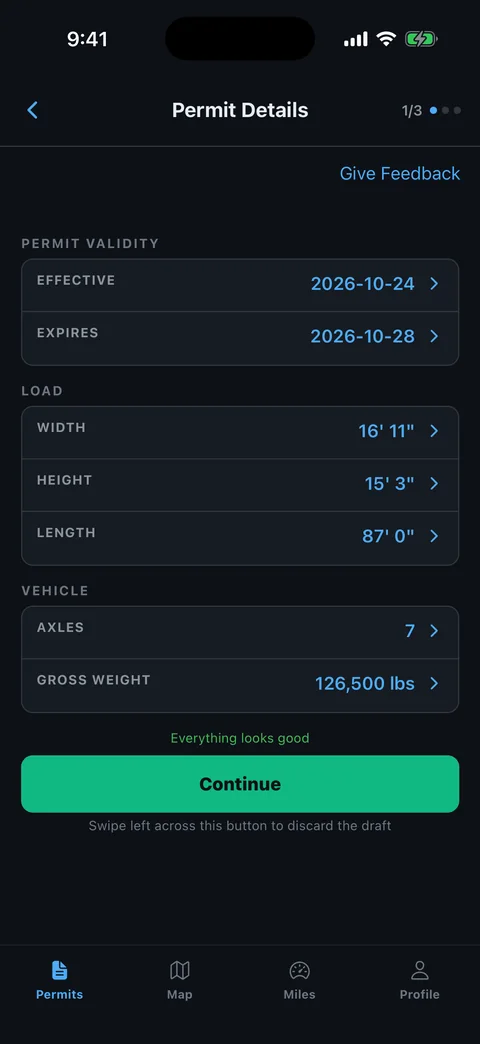
What PF-2, PF-8 and the other NCDOT forms mean is covered in how to read a North Carolina oversize permit. RouteAll reads the permit you upload and drives the route it names, so the roads on the screen are the roads NCDOT approved. It never reroutes you off the permit.
What are North Carolina's bridge and clearance rules?
NCDOT sets the maximum weight on each permitted route by the capacity of the bridges it crosses, and denies moves that could damage them. Height is your job: the permit does not promise the load fits under anything on the route.
"The issuance of any permit shall not imply nor guarantee the vertical clearance of the permitted load and the permittee shall be responsible for ensuring all vertical clearances prior to movement." — 19A NCAC 02D .0601(e). Verified November 3, 2026.
- 12 feet 6 inches: North Carolina need not build any structure taller than that, and an owner whose vehicle is taller is liable for the damage it causes (G.S. 20-116(c)).
- Over 14 feet high: apply in writing at least two business days ahead (.0601(d)).
- Light-traffic roads: NCDOT can post secondary roads with axle limits below the statutory ones (G.S. 20-118(b)(4)). NCDOT links its posted bridge and posted road lists on its permit page.
- Surety bond: NCDOT can require one when a move may damage a highway or bridge (.0602(a)(1)).
The bridge check covers the permitted route only, so read what happens if you leave your permitted route.
When does North Carolina require a pilot car?
Over 12 feet wide, North Carolina requires an escort in front on two-lane, two-way highways and behind on multilane highways, or as the permit states. Over 14 feet 5 inches high, a front pole car runs the whole route. Over 16 feet wide, three escorts go along and one must be the State Highway Patrol.
Length, overhang and weight set their own triggers, listed below.
| Load | Escorts | Source |
|---|---|---|
| Over 12 feet wide | Front on two-lane roads; rear on multilane roads | E-9 |
| Over 16 feet wide | Three in total, one from the State Highway Patrol | E-9 |
| Over 14 feet 5 inches high | Front pole car with a height pole | E-9 |
| Over 110 feet long | One rear; front and rear over 150 feet | E-9 |
| Rear overhang 15 feet or more | One rear | E-9 |
| Over 149,999 pounds | One front | E-9 |
Every escort driver must be certified and carry the credential (19A NCAC 02D .0643). Certification takes an eight-hour NCDOT course and an exam passed at 75 percent, lasts four years and accepts other states' approved programs (.0644). A Class A CDL holder may sit the exam without the course (G.S. 20-119(f)). Running without the right number of certified escorts costs the registered owner $1,500 (G.S. 20-119(d)(1)).
More on credentials is in North Carolina pilot car qualifications and pilot car requirements by state.
When can an oversize load move in North Carolina?
Permitted loads move Monday through Sunday, sunrise to sunset, unless the permit says otherwise. NCDOT allows continuous travel, 24 hours a day all year, up to 112,000 pounds gross and 10 feet wide when nothing else is over legal (NCDOT notice).
"No movements shall be made when visibility is less than 500 feet." — 19A NCAC 02D .0607(a)(8). Verified November 3, 2026.
- Rush hour: over 12 feet wide, no travel within 10 miles of the Charlotte, Raleigh, Durham or Chapel Hill city limits from 7 to 9 a.m. and 4 to 6 p.m. (ST-1).
- Holidays: oversize loads and loads over 112,000 pounds stop from noon on the weekday before Independence Day, Thanksgiving and Christmas until noon on the weekday after (NCDOT handbook).
- Rest of 2026: no travel from noon Wednesday, November 25 to noon Friday, November 27, or from noon Thursday, December 24 to noon Monday, December 28 (2026 holiday schedule).
- Spacing: permitted vehicles from the same company or the same origin stay at least 2 miles apart, and convoys are not allowed (.0607(a)(4)).
- Speed: never above the posted limit, and the permit can set a lower one (.0607(a)(6)).
Other states' windows are compared in oversize load travel restrictions by state.
What signs, flags and lights does North Carolina require?
Over 10 feet wide, North Carolina requires a yellow OVERSIZE LOAD banner totaling 7 feet by 18 inches on the front and rear bumpers, with 10-inch black letters in a 1.5-inch brush stroke. It may be split into two pieces. Over 8 feet 6 inches wide, 18-inch red or orange flags go at the widest points.
- Flags: mounted so they do not add to the overall width (.0607(b)(2)).
- Night lamps: between sunset and sunrise, a load over 102 and up to 120 inches wide needs at least two amber lamps at its widest points (NCDOT notice).
- Flashing amber lights: otherwise used as the issuing permit office determines (.0607(b)(5)).
- Escort banner: the same lettering, run the full width of the escort's bumper (E-9).
More detail is in North Carolina oversize load signs, flags and lights, and other states are in sign requirements by state.
What is a superload in North Carolina?
A load 15 feet wide or more, or 132,000 pounds or more, needs a superload permit, applied for in writing at least 10 business days ahead (.0601(c)). The Chief Engineer approves it after analysing the load and the route. It is valid 10 calendar days for a one-way trip, and the return needs a separate application (.0602(e)).
An application that needs an engineering study for pavement or structures carries a $100 nonrefundable fee on top of the permit fee (G.S. 20-119(b)).
What trips drivers up in North Carolina?
- Leaving the route: moving off the permitted route is a $500 civil penalty, and the Highway Patrol can add up to $10,000 more (G.S. 20-119(d)).
- Wrong hours: traveling in violation of time-of-travel restrictions is a $250 penalty.
- Side-by-side loads: several items loaded side by side may not exceed 8 feet 6 inches wide, and stacked items may not exceed 13 feet 6 inches high (.0602(a)).
- City streets: the state permit stops at the municipal line, so plan the last mile with the town.
- Forgotten paper: an officer who can confirm a valid permit electronically will not cite you for not carrying it (G.S. 20-119(h)). Carry it anyway.
Use This Check In RouteAll
After receiving the issued permit, use RouteAll’s permit-to-GPS workflow to compare its highway sequence with a reviewable map. Keep local permissions, travel windows and escort instructions available separately. RouteAll does not issue permits or amend the authorized roads.
Before you roll
Over 8 feet 6 inches wide, flag the widest points; over 10 feet, hang the banners. Over 12 feet wide, book a certified escort and stay clear of the four metro areas at rush hour. Check every clearance yourself, since the permit does not. Stop at noon before a holiday. For a fuel or rest stop on I-95, see the North Carolina truck stop guide.
Common questions
How much is a North Carolina oversize permit?
A single-trip permit costs $12 for each dimension over the legal limit, counting height, length, width and weight up to 132,000 pounds, under G.S. 20-119(b). Above 132,000 pounds add $3 per 1,000 pounds. An annual permit for most commodities costs $185.
Can oversize loads travel at night in North Carolina?
Only some. NCDOT allows round-the-clock travel up to 112,000 pounds and 10 feet wide when the load has no other over-legal dimension. Other permitted loads move sunrise to sunset unless the permit says otherwise.
Can oversize loads travel on weekends in North Carolina?
Yes. NCDOT's single-trip publication authorizes travel Monday through Sunday, sunrise to sunset, unless the permit says otherwise. The holiday periods around Independence Day, Thanksgiving and Christmas are the exception.
What escort do I need in North Carolina at 13 feet wide?
One certified escort: in front on two-lane, two-way highways and behind on multilane highways, or as the permit states. Over 16 feet wide, three escorts are required and one must be the State Highway Patrol.
What is PIMS in North Carolina?
PIMS, the Permit Information Management System, is NCDOT's online system for ordering oversize and overweight permits. Since August 1, 2025, the Permit Unit no longer accepts faxed applications.
When can't oversize loads travel at Thanksgiving 2026 in North Carolina?
From noon Wednesday, November 25, 2026 until noon Friday, November 27, 2026, for overwidth, overheight or overlength loads and loads over 112,000 pounds, per NCDOT's 2026 holiday schedule.
Further reading
Sources
- N.C. General Statutes 20-116 (size), 20-118 (weight) and 20-119 (special permits and fees).
- 19A NCAC 02D .0601, .0602, .0607, .0643 and .0644, Office of Administrative Hearings.
- NCDOT, Oversize/Overweight Trucking Permits, including the continuous travel update, and PIMS.
- NCDOT, Single Trip Permits, Publication ST-1, and Escort Vehicles, Publication E-9 (revised August 2024).
- NCDOT, Oversize/Overweight Permit Handbook and Holiday Closings 2026.
RouteAll reads the permit you provide. It does not issue permits or guarantee compliance. The driver remains responsible for the load. North Carolina rules change, and your permit can be stricter than the rule; verify against the permit and the NCDOT Oversize/Overweight Permit Unit before every move.