 RouteAll
Utah Permit Reading Guide
Sources Reviewed: October 23, 2026
Read a Utah permit together with every required clearance or approval. Compare the load, vehicle, requested roads and printed conditions. Some bridge approvals apply to a single move, and special oversize permission can depend on regional or utility clearances that must be complete before travel.
On This Page
Which Utah Approvals Belong With The Permit?
Collect the issued Utah permit and every clearance or supporting approval required for that movement. UDOT's non-divisible-load provisions describe moves that depend on regional and utility clearance. A permit package may involve more than the document produced by the online order.
Make a list from the instructions actually attached to your trip. Keep each approval associated with the load and route it addresses, rather than saving a collection of similar documents from earlier hauls.
- Issued permit: Verify its category, current dates and equipment.
- Structure approval: Retain any bridge evaluation required for the configuration.
- Regional clearance: Locate any condition governing the affected roads.
- Utility coordination: Confirm any required clearance or arranged support.
- Escort instruction: Identify who must accompany the movement and where.
Resolve a missing approval before treating departure as the next step. Route approval and crew readiness need their own checks.
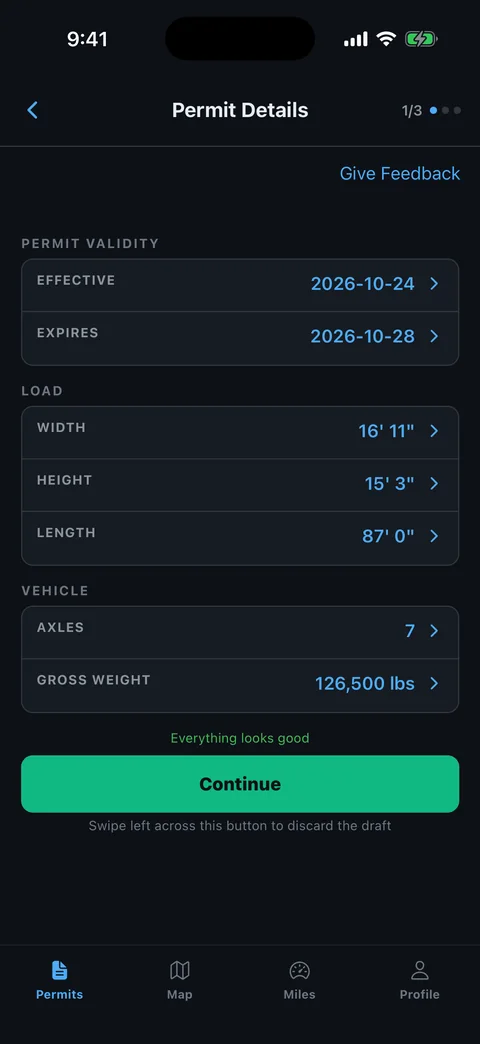
Which Utah Equipment Fields Should You Compare?
Compare the Utah permit with the registered vehicle and loaded configuration. UDOT's general provisions identify vehicle, load, dimension and axle-spacing information used in the application. These details give you a practical order for checking the issued document.
Measure after loading and securement. A machine lowered for transport or an attachment repositioned on the trailer can change the figures that matter.
- Vehicle identity: Match the plate, unit and complete identifier where shown.
- Registered weight: Keep it distinct from the loaded gross weight.
- Overall dimensions: Review height, width, length and front or rear overhang.
- Axle configuration: Compare the actual axle arrangement and spacings for an overweight movement.
- Journey: Check the origin, destination and permit period against the planned trip.
The common permit errors guide helps you document changes clearly before asking the issuer to correct a permit.
Can You Reuse A Utah Bridge Approval?
Do not assume a prior bridge clearance covers a repeat move. UDOT's dual-lane-trailer guidance says the described Structures Division approvals are single-trip approvals, including repeat configurations. That statement is specific to those approvals, not a claim that every Utah permit needs a separate bridge document.
Identify what was approved and for which movement. Compare the current truck, trailer, axle arrangement, load and route with the supporting approval before scheduling the trip.
- Find the approval: Match the document to this permit package.
- Compare the setup: Check axle configuration and the loaded measurements.
- Check the roads: Confirm the evaluated route matches the intended movement.
- Ask about reuse: Obtain issuer direction when relying on anything from an earlier move.
Keep the answer with the trip notes. A previous successful crossing is useful background for the discussion, but it does not establish the authority for today's movement.
What Do Regional Or Police Conditions Mean?
A special Utah movement may require regional authorization, utility clearance, certified pilot escorts or police coordination. Read the conditions for your actual load. UDOT's special oversize provisions explain that specified required clearances must be received before the permit is valid for that operation.
Convert each condition into an action assigned to a person. Avoid a trip note that merely says special escorts, without identifying the operation or the meeting arrangements.
- Location: Mark the road section or structure requiring coordination.
- Authority: Identify which organization grants or arranges the required support.
- Personnel: Confirm who will be present and in what role.
- Timing: Match the arranged movement with the approved travel period.
- Confirmation: Keep the final instruction with the permit package.
The escort route-sharing guide helps everyone discuss the same trip. Sharing a route does not book police support or complete a clearance.
How Do You Read Utah’s Route And Travel Conditions?
Read the Utah route and applicable travel restrictions together. UDOT's general provisions link separate weather, congestion and holiday rules. A permit's date range does not answer whether a particular road segment can be used at the time you intend.
Trace the roads before estimating the schedule. Identify unfamiliar junctions, short connectors and any instruction tied to a particular segment.
- Follow the sequence: Locate the permitted start, each road change and the permitted finish.
- Mark conditions: Keep restrictions beside the road segment they affect.
- Plan waiting: Confirm an appropriate place to stop before a restriction or arranged operation.
- Resolve a conflict: Ask the issuer about a changed road condition or equipment mismatch.
Our travel-time planning guide explains that schedule review. Do not use a navigation detour as a substitute for the issuer's correction.
How Can RouteAll Help With A Utah Permit?
RouteAll can extract a printed permit route from a PDF or photo for your manual review. With a Utah movement, keep any separate structure or coordination approval beside the route. A proposed map does not establish that those departure requirements have been completed.
Use the PDF permit to GPS workflow with a complete readable document. Check the roads in sequence rather than approving the map because its endpoint is correct.
- Route changes: Compare each road number, direction and connecting turn.
- Trip boundaries: Match the authorized start and finish.
- Supporting approval: Keep bridge and special-operation instructions accessible.
- Corrections: Repeat the review when the issuer sends a revised permit or route.
RouteAll does not issue Utah permits, amend them or guarantee that a load clears a structure. The driver reviews the extracted route and confirms it before navigation.
Read Utah’s route and travel conditions together, then follow the oversize permit route turn by turn inside the travel hours it allows.
The Permit Check In One Minute
A Utah permit review should include any separate approval required for the movement. Match the vehicle and measured load, including axle arrangement, registered weight and loaded gross weight as distinct entries. Read the route with its travel conditions. If the package includes a Structures Division approval, check whether it applies to this specific move instead of assuming an earlier approval can be reused. Confirm any regional, utility, pilot-car or police coordination before departure. Ask the issuer to resolve a changed setup or route conflict. RouteAll can turn a legible permit into a route for manual review, while the original permit and supporting clearances remain part of the trip.
Before You Roll
Verify that every required Utah clearance belongs to this move and is complete. Compare the approved equipment and route again after any configuration change.
Further Reading
Sources And Scope
This guide explains how to read the state’s published permit material. Your issued permit and incorporated conditions govern the move. Check the linked agency material for updates.
- General Oversize Or Overweight Provisions — Paper/electronic possession; permit durations; application data; single-trip Structures approvals; travel restriction references.
- Oversize Non-Divisible Load Provisions — Regional and utility clearance; escort coordination; permit validity conditional on required clearances.