 RouteAll
Louisiana Oversize Load Permits: LaGeaux, Escorts, Curfews
Last verified November 3, 2026 against the Louisiana statutes and DOTD documents linked below.
A Louisiana load needs a DOTD permit once it is wider than 102 inches, taller than 13 feet 6 inches, or over the length and 80,000-pound limits. The DOTD Truck Permit Office issues permits through LaGeaux. An oversize permit costs $10 a day per trip; overweight fees run by weight and miles.
On This Page
Most Louisiana permit loads move from sunrise to sunset only. This page covers that and the rest, each linked to the rule.
What are the Louisiana legal size limits?
Louisiana allows 102 inches wide, 13 feet 6 inches high and 80,000 pounds gross without a permit. A vehicle that runs only on Interstates may stand 14 feet high. A single vehicle stops at 45 feet, and the semitrailer in a tractor combination at 59 feet 6 inches.
The table lists each limit with its source.
| Dimension | Legal limit | Source |
|---|---|---|
| Width | 102 inches, safety devices excluded; a load may project 12 inches past the body | R.S. 32:380 |
| Height | 13 feet 6 inches; 14 feet for vehicles that run only on Interstates | R.S. 32:381 |
| Single vehicle | 45 feet long | R.S. 32:382 |
| Semitrailer | 59 feet 6 inches in a tractor-semitrailer combination | R.S. 32:382 |
| Projection | 4 feet in front; 8 feet past the rear of the bed | DOTD book, p. 10 |
| Weight | 80,000 pounds gross; 22,000 single and 37,000 tandem off the Interstate | DOTD book, p. 7 |
Over 13 feet 6 inches, the driver must make sure the load clears every structure in its path (R.S. 32:381).
How do you get a Louisiana oversize permit?
Apply in LaGeaux, the DOTD Truck Permit Office's online system, before the load enters Louisiana. Weigh stations do not sell permits. An oversize permit costs $10 a day per trip, and an overweight trip permit, priced by weight and miles, stays active 5 days. Call 800-654-1433, option 1.
The Louisiana Department of Transportation and Development (DOTD) needs a $100,000 auto liability certificate on file before it issues any permit. Upload it as a PDF under the Management tab in LaGeaux. DOTD does not accept certificates by mail, fax or email.
The driver, or the escort, carries the permit on paper or a screen. It covers only the named permittee and cannot be transferred.
DOTD issues these oversize and overweight permit types (2026 regulations book, single trip permits):
- Oversize permit: $10 per day per trip for loads over legal length, width, height or projection.
- Overweight permit: one trip, active 5 days, priced by gross weight and miles. Oversize dimensions on it cost nothing extra.
- Monthly oversize: $10 for each valid day, up to 90 feet long, 12 feet wide and 14 feet 4 inches high.
- Yearly oversize: $500 for legal-weight loads within the same 90-foot, 12-foot and 14-foot-4-inch caps.
- Annual overweight: $2,500 for heavy equipment up to 120,000 pounds. New ones need a registered route approved before each move.
Overweight fees for five or more axles follow DOTD's Schedule #3.
| Gross weight | 0 to 50 miles | Over 200 miles | Source |
|---|---|---|---|
| 80,001 to 100,000 pounds | $45 | $150 | Schedule #3 |
| 100,001 to 108,000 pounds | $75 | $330 | Schedule #3 |
| 108,001 to 120,000 pounds | $105 | $465 | Schedule #3 |
| 120,001 to 132,000 pounds | $135 | $622.50 | Schedule #3 |
| 232,001 to 254,000 pounds | $442.50 | $2,130 | Schedule #3 |
Axle-only overweight loads, two- and three-axle units and four-axle combinations use Schedules #1 and #2, which start at $30. Route approvals currently take 2 to 4 business days, DOTD's permit page says.
Registered routes and revisions are covered in the Louisiana permit reading guide. Annual vs single-trip oversize permits compares the choices.
Which Louisiana bridges and tunnels restrict permit loads?
Permit loads may not use either Louisiana tunnel, in Harvey on US 90 Business or Houma on LA 3040. No load may cross a bridge above its regulatory weight posting. The New Orleans Mississippi River bridges and the US-190 bridge in Baton Rouge close to many permit loads at rush hour.
"Bridges posted with regulatory weight limit signs (black lettering on a white background) shall not be crossed by vehicles and loads exceeding the posted limits." — DOTD regulations book, p. 13. Verified November 3, 2026.
- Regulatory postings carry tickets from $100, rising with the excess weight. Advisory postings, black on yellow, leave the call to the driver.
- New Orleans river bridges: no permit vehicle may cross or come within 2 miles of them 6:30 to 9 a.m. and 3:30 to 6 p.m. weekdays.
- US-190 in Baton Rouge: loads over 8 feet 6 inches wide, 14 feet 4 inches high, 70 feet long or 120,000 pounds stay off it at the same hours. So do projecting loads.
- Reasonable access lets a routed permit leave the route for fuel, repairs, food or rest. Overpasses, posted bridges and construction zones stay off limits.
- Over 232,000 pounds on non-designated highways, or 254,000 anywhere, a load must use rail or water where they can carry it.
DOTD's Trouble Board and Route Planner show current restrictions. The Louisiana truck stop guide checks TA Slidell on I-10 against a permit route.
Leaving the route has its own costs; see what happens if you leave your permitted route.
When does Louisiana require a pilot car?
Louisiana requires a private escort over 12 feet wide up to 16 feet, and over 90 feet long up to 125 feet. Over 16 feet wide or 125 feet long, State Police escort the load instead. Loads over 18 feet wide need State Police in front and behind. Height adds a pole truck from 15 feet 10 inches.
Height and length set their own triggers, listed below.
| Load | Escort | Source |
|---|---|---|
| Over 12 feet up to 16 feet wide | Private escort | DOTD book, p. 35 |
| Over 90 feet up to 125 feet long | Private escort, behind the load on every highway | DOTD book, pp. 35, 61 |
| Over 16 feet wide or 125 feet long | State Police; over 125 feet, a steerable dolly | DOTD book, p. 35 |
| Over 18 feet wide | State Police in front and behind | DOTD book, p. 35 |
| Over 15 feet 10 inches high | Pole truck in front on state highways; Interstate-only moves exempt | DOTD book, p. 35 |
| Over 18 feet high | Bucket trucks; State Police may be required front and rear | DOTD book, pp. 35-36 |
One escort may cover two overlength loads but only one overwidth load. It drives in front on two-lane roads and behind overwidth loads on multilane roads. A load that needs both an escort and a height pole on a multilane road runs two cars. Escorted loads never exceed 55 mph.
Each private escort car needs a Louisiana Escort Vehicle Permit, $10 a year and expiring December 31. It also needs $500,000 each of general liability, auto liability and workers' compensation coverage (R.S. 32:387.1).
Driver credentials are in Louisiana pilot car qualifications, and other states in pilot car requirements by state.
When can an oversize load move in Louisiana?
Permit loads normally move from sunrise to sunset, as set by the National Weather Service. Night, severe weather and certain holidays are closed. A load inside the vehicle's edges, at legal width and length, 14 feet 4 inches or lower and 120,000 pounds or less, is typically exempt.
"Wet pavement, light drizzle and wind are not considered inclement weather for the purposes of permit movement." — DOTD regulations book, p. 38. Verified November 3, 2026.
- Interstate rush hours: loads over 12 feet wide stop 7 to 9 a.m. and 3:30 to 5:30 p.m. weekdays on listed stretches. They are in Shreveport, Monroe, Lake Charles, Baton Rouge and New Orleans.
- New Orleans streets: loads over 12 feet wide stay off city streets 7 to 9 a.m. and 3:30 to 6 p.m. weekdays. Interstates and US 90 Business to the Crescent City Connection are excepted.
- Holidays: DOTD bars permit moves on certain designated holidays but does not list them in its 2026 book. Read the dates on your permit.
- Severe weather: heavy rain, heavy fog, ice or snow stop the move. A load already rolling must pull off and park until it clears.
- Darkness: escorted loads need Truck Permit Office and State Police approval to move at night.
Other states' windows are in oversize load travel restrictions by state.
What signs, flags and lights does Louisiana require?
Over 10 feet wide, Louisiana requires two OVERSIZE LOAD signs, on the front of the vehicle and the rear of the load. Each is at least 7 feet by 18 inches, black on yellow, with 10-inch letters. Overwidth loads take four red or fluorescent orange flags, 18 inches square, at the widest front and rear edges.
Overlength loads and long rear overhangs carry their signs on the sides of the overhang. A rear overhang over 4 feet takes flags unless it clears the pavement by 6 feet. DOTD does not accept WIDE LOAD signs.
Lights matter only for permitted night or bad-weather moves. Amber lights mark the front edges of the overwidth part and red lights the rear, visible at 500 feet.
Layouts are in the Louisiana signs, flags and lights guide.
What is a superload in Louisiana?
Louisiana handles its heaviest moves as super-loads, and DOTD says they now take up to 6 to 8 weeks. Apply in LaGeaux with every axle weight, spacing, tire count and tire size. Over 232,000 pounds, apply 4 to 6 weeks ahead for structural review. Over 900,000 pounds, an independent engineering firm may be needed.
Over 254,000 pounds, the fee is $15 plus $0.75 per ton-mile over 80,000 pounds, plus structural evaluations. Each evaluation costs $187.50 to $1,275 by structure type, and every Mississippi River structure takes the top rate.
Over 16 feet 5 inches high, get a pre-approved route at least 48 hours before the move. Over 18 feet high, contact each DOTD district office on the route first; each utility must clear its lines.
Use This Check In RouteAll
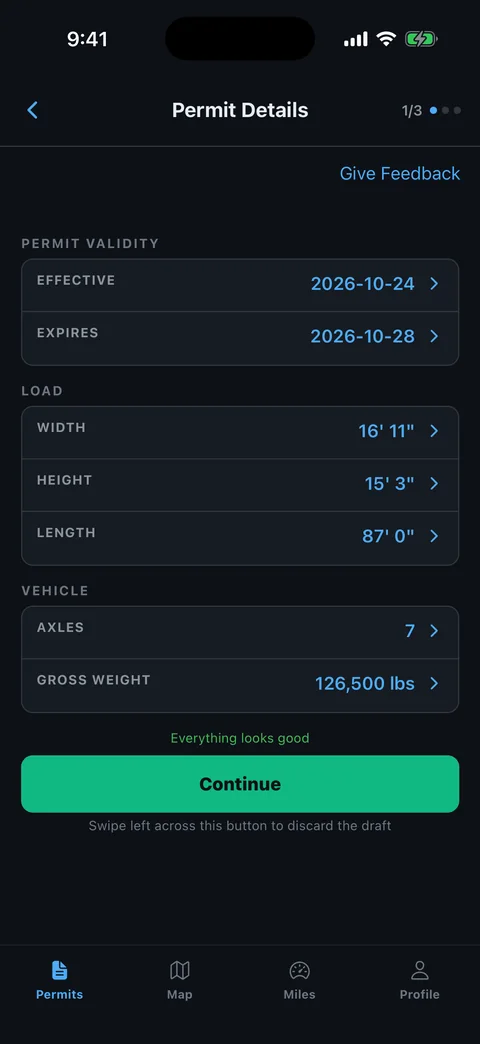
After DOTD issues the permit, use RouteAll’s permit-to-GPS workflow to compare its road list with a reviewable map. RouteAll keeps you on the roads the permit names and never reroutes you off them. One free trip every month covers up to 6 state permits, with no card to start. Keep registered-route approvals and local permissions with the driver, because RouteAll does not issue permits or amend the authorized roads.
Before you roll
Put the insurance certificate in LaGeaux before you order, and get the permit before the state line. Over 12 feet wide, book an escort and plan around the Interstate rush hours. Stay out of both tunnels and off any bridge posted below your weight. Park when heavy rain, fog or ice arrives.
Common questions
How much is a Louisiana oversize permit?
An oversize permit costs $10 a day per trip. A monthly oversize permit costs $10 for each valid day, and a yearly one costs $500. Overweight trip permits are priced by gross weight and miles, starting at $30 on DOTD's fee schedules.
Can oversize loads travel at night in Louisiana?
Generally no. Permit loads move from sunrise to sunset. A load that stays inside the vehicle at legal width and length, 14 feet 4 inches or lower and 120,000 pounds or less, is typically allowed at night. Escorted loads need Truck Permit Office and State Police approval.
When do I need a pilot car in Louisiana?
A private escort is required over 12 feet wide up to 16 feet, or over 90 feet long up to 125 feet. Over 16 feet wide or 125 feet long, State Police escort the load. Loads over 15 feet 10 inches high also need a pole truck in front on state highways.
What is LaGeaux?
LaGeaux is the Louisiana DOTD online permit system for oversize and overweight loads. Customers order permits, upload insurance certificates and register annual-permit routes there. The Truck Permit Office answers at 800-654-1433, option 1.
Can a permit load use a Louisiana tunnel?
No. DOTD prohibits oversize and overweight permit loads in both tunnels, in Harvey on US 90 Business and in Houma on LA 3040. Hazardous, flammable and combustible materials are barred there too.
Does Louisiana accept WIDE LOAD signs?
No. Louisiana requires the wording OVERSIZE LOAD on permit loads, and DOTD will not accept WIDE LOAD signs. Each sign is at least 7 feet by 18 inches, with black letters on yellow.
Further reading
Sources
- Louisiana Revised Statutes 32:380 (width), 32:381 (height), 32:382 (length), 32:387 (special permits) and 32:387.1 (escort services).
- DOTD, Louisiana Regulations for Trucks, Vehicles, and Loads, updated 2026: legal limits, permit types, fee schedules, escorts, travel restrictions, flags, signs and lights.
- DOTD, Oversize and Overweight Truck Permits and Single Trip Permits pages: LaGeaux, registered routes, processing times and escort permit expiry.
- DOTD LaGeaux permit system, Trouble Board and Route Planner.
RouteAll reads the permit you provide. It does not issue permits or guarantee compliance. The driver remains responsible for the load. Louisiana rules change, and your permit can be stricter than the rule; verify against the permit and the DOTD Truck Permit Office before every move.