 RouteAll
Oklahoma Permit Reading Guide
Sources Reviewed: October 23, 2026
Read an Oklahoma permit by identifying its permit type before interpreting its roads and conditions. An annual envelope permit has different route authority from a trip permit. Match the equipment and load, then read the route, current restrictions and travel limits together.
On This Page
Which Oklahoma Permit Type Are You Holding?
Identify whether your document is a trip permit or an annual envelope permit before planning the journey. Oklahoma's size-and-weight permit rules give annual envelope permits a designated route network. Do not apply those network permissions to a different permit category.
Put the permit type at the top of your working trip notes. Then write the vehicle covered, the allowed period and the type of load. That makes it easier to catch a permit attached to the wrong dispatch.
- Trip document: Read the origin, destination, roads and move-specific conditions.
- Annual envelope: Match the applicable map, equipment and envelope restrictions.
- Special movement: Find any additional approval or instruction associated with the load.
Our annual versus single-trip permit guide explains why a longer validity period does not mean unrestricted routing.
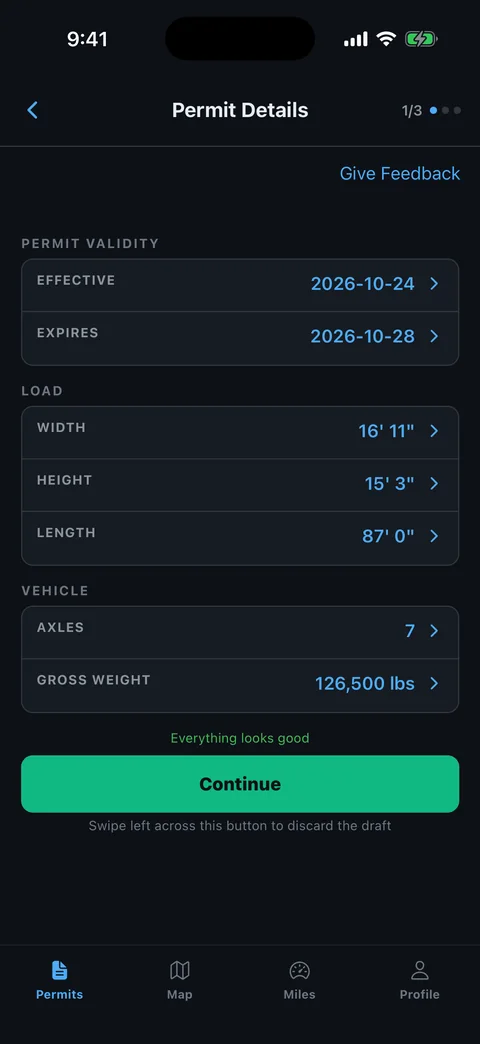
How Do You Check The Oklahoma Load Description?
Compare the permit with the complete loaded combination, including projections beyond the trailer. A machine's advertised dimensions can differ from its transport configuration. Check the document after the equipment has been loaded and secured, not only when the application is ordered.
Read each weight or spacing value in its own unit. A correct gross weight does not establish that an axle entry is correct.
- Identity: Match the listed carrier, power unit and trailer with today's assignment.
- Overall size: Measure transport height, width and length, including attachments left on the load.
- Overhang: Keep front and rear projections separate from trailer length.
- Axle arrangement: Compare the number, weights and center-to-center spacings shown.
- Travel dates: Read effective and expiration information before setting an appointment.
Use the permit errors checklist to document a mismatch. Send the actual difference to the issuer rather than assuming a higher total covers it.
What Do Green Routes Mean On An Annual Envelope Permit?
Oklahoma's annual envelope rule limits that authority to green routes on the current annual envelope map and excludes Interstate highways. The carrier must also keep the map current. That is a specific permit category, not a description of every Oklahoma oversize move.
Use the annual envelope provisions to identify the applicable map and conditions. For a trip permit, trace the roads approved for that trip instead. Do not splice the most convenient parts of two permit types together.
- Locate each segment: Follow the route from the actual state entry or loading point.
- Compare map authority: Check the route against the map required by your permit category.
- Review transitions: Identify access roads, ramps and changes between highway systems.
- Check the destination: Ask about jurisdiction and permission for any final road not clearly covered.
Keep a written question list for any gap. A highlighted map is useful only when it matches the authority you actually hold.
Which Oklahoma Travel Restrictions Apply Today?
Oklahoma's official guidance treats oversized movement differently from overweight-only movement. It also lists weekday Interstate curfews in Cleveland, Oklahoma and Tulsa counties. Read the current size-and-weight guidance together with your permit before choosing when to cross those areas.
Build the schedule around the restricted segment, rather than the distance from the yard. A departure that seems early enough can still place the load at a county boundary during a prohibited period.
- Load category: Identify every dimension for which the move needs permission.
- Route location: Note which approved roads enter a listed metro county.
- Time zone: Keep the official Central Time restrictions separate from a dispatch screen using another zone.
- Waiting location: Confirm an appropriate place to wait before the restricted segment.
The travel-time planning guide helps structure the calculation. It does not replace the current Oklahoma rule or a condition on your permit.
How Should You Handle An Oklahoma Restriction Or Correction?
Use the restriction list linked by Oklahoma's permit office to check for conditions affecting your approved roads. If a restriction conflicts with the permit, ask the issuer for direction before entering that segment. Do not treat an ordinary traffic detour as an amended permit.
The official permit page links both a restriction list and municipal contacts. Those are useful starting points when a route problem involves construction or a locally controlled road.
- Identify the issue: Record the road, direction, nearby junction and restriction description.
- Supply the configuration: Include the permit number and relevant size or axle details.
- Request correction: Ask the permit office or ordering service which authorization must change.
- Review the replacement: Compare the entire route, not just the road mentioned in the call.
Share the resolved instructions with the rest of the haul team. Keep a superseded permit out of the active document set.
How Can RouteAll Help With An Oklahoma Permit?
RouteAll can help extract the printed route from a permit PDF or photo, followed by your manual review. For Oklahoma, first resolve which permit category and route authority you hold. A navigation line cannot decide whether an annual envelope route or a trip route authorizes your movement.
Follow the PDF permit route workflow with a legible copy. Compare the road sequence, entry point and final permitted segment before confirming it.
- Short connectors: Check ramps and numbered-road transitions instead of judging the route by its overall shape.
- Restrictions: Keep the issuer's current conditions beside the route review.
- Corrections: Recheck the route after an amended document arrives.
- Escort coordination: Use the pilot-car route sharing guide to keep the team reviewing the same trip.
RouteAll does not issue Oklahoma permits, amend their authority or certify that a road is clear for your load.
Whether the Oklahoma permit is single-trip or an annual envelope, follow the oversize permit route turn by turn on the roads it allows that day.
The Permit Check In One Minute
Begin an Oklahoma permit review by identifying the permit type. A trip permit and an annual envelope permit do not give the same routing authority. Match the carrier, truck, trailer, measured dimensions and axle information with the loaded equipment. Trace the approved roads and review current restrictions. If you use annual envelope authority, check the current green-route map and its Interstate exclusion. Plan travel times from the applicable load category and metro restrictions, not only from the permit dates. Send any equipment mismatch or route conflict to the permit office or ordering service. RouteAll can organize a legible printed route for your review, but the app does not grant permission or amend a permit.
Before You Roll
Identify your Oklahoma permit category and check its own route authority. Resolve a construction restriction or vehicle mismatch with the issuer before confirming the trip.
Further Reading
Sources And Scope
This guide explains how to read the state’s published permit material. Your issued permit and incorporated conditions govern the move. Check the linked agency material for updates.
- Oklahoma Size And Weight Permits — Travel categories; metro curfew guidance; restriction and municipal-contact resources.
- Size And Weight Permit Load Rules — Annual envelope map authority, Interstate exclusion, carrier responsibility for current maps and restrictions.