 RouteAll
Minnesota Permit Reading Guide
Sources Reviewed: October 23, 2026
Read a Minnesota oversize permit with its approved route, applicable trip-log authorization, and general provisions. Compare any physical route survey with the final route. Check the loaded combination and local-road permissions separately; a MnDOT permit does not increase vehicle registration weight.
On This Page
What Belongs in a Minnesota Permit Package?
Keep the issued permit, approved route or trip-log authorization, and applicable general provisions together. Add the survey and movement-specific material when required. An annual permit is not enough to interpret every trip without checking its routing requirements.
MnDOT's permit-type page identifies different authorizations and route-approval requirements. The general provisions identify annual categories and conditions that require trip-log preauthorization.
- Permit type: Read the category rather than assuming all annual permits work alike.
- Movement approval: Confirm any required routing or trip-log step is complete.
- Conditions: Keep the general and movement-specific instructions available.
- Survey: Match required survey material with the route being dispatched.
For clarity, put the permit and its matching trip material in one dispatch folder. Read annual versus single-trip permits if you are unfamiliar with that distinction.
Which Minnesota Load and Registration Details Matter?
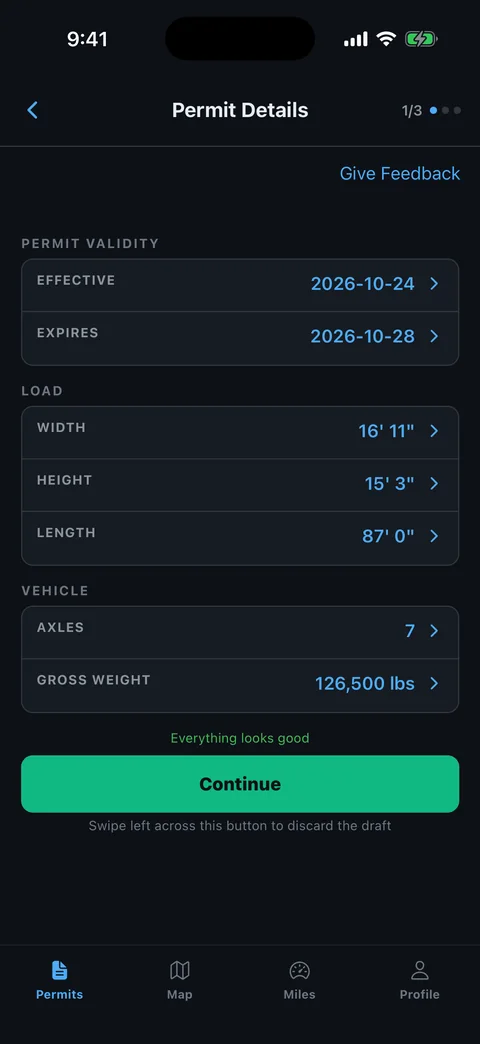
Compare the actual loaded combination with both the permit and its supporting information. A correct gross number alone does not establish that the axle configuration, dimensions, and route authorization describe the departing vehicle.
The Minnesota general provisions state that the permit does not increase registered vehicle weight. Registration and oversize/overweight routing are separate checks. Resolve both before relying on the packet.
- Loaded size: Compare width, height, overall length, and projections.
- Axles: Match the actual configuration and weight distribution with the authorization.
- Equipment: Check the power unit and trailer information where specified.
- Registration: Confirm registration questions through the appropriate registration channel.
Use current measurements after loading. If equipment or cargo position changes, identify which permitted fields are affected rather than assuming the route remains suitable. Keep the issue in writing so the permit office can evaluate the actual change.
How Do You Compare the Physical Survey With the Permit?
When a physical route survey is required, compare its route and load details with the final approved movement. MnDOT says the permit application route must match the survey route. A survey covering a nearby approach does not explain a missing or changed segment.
The MnDOT route-survey page describes physical surveys, clearance checks, rail-grade crossings, and identification of special maneuvers. It also distinguishes a required survey from simply using a pole vehicle.
- Match the itinerary: Compare the survey's start, finish, and highway sequence.
- Match the load: Check the surveyed dimensions against the loaded combination.
- Locate maneuvers: Identify instructions involving lanes, turns, or obstructions.
- Check coordination: Confirm required arrangements for utility or infrastructure work.
Keep questions tied to a precise location. Ask the office or survey preparer about an unclear entry before the truck reaches it. Do not infer clearance from a map line that omits the survey's operating notes.
Where Does the Minnesota State Permit Stop?
Check every county, municipal, township, or other local road separately from the MnDOT authorization. The general provisions require approval from the appropriate road authority before using county or local roads. A final delivery address does not answer that question.
MnDOT's permit-type guidance describes state roads, highways, and Interstate coverage unless otherwise noted. Use the actual permit and the responsible local authority to resolve the remaining segments.
- Pickup approach: Trace the public roads between the site and state route.
- Delivery approach: Check the last authorized road and the receiver's entrance.
- Connecting section: Identify any local road used between state highways.
- Return movement: Check its route and permissions rather than reversing your notes.
A useful dispatch packet makes the authority boundary visible. The first permitted-route planning guide helps organize transitions without confusing mapping with road permission.
Which Conditions Can Interrupt a Minnesota Move?
Read the written weather, road, travel-time, and support conditions before setting your itinerary. Minnesota's general provisions address hazardous conditions, postings, warning devices, pilot escorts, and travel restrictions. Your issued permit may also contain specific instructions.
Use the MnDOT general provisions that accompany the authorization. Avoid applying a remembered holiday or summer schedule without checking the conditions for this load.
- Road conditions: Check restrictions along the entire approved route.
- Travel window: Identify which size-related or permit-specific timing conditions apply.
- Warning devices: Match the required equipment with the actual vehicle and load.
- Escorts: Confirm the required operators and arrangements before dispatch.
Read travel-time and curfew restrictions for the planning distinction between permit validity and the hours when movement is allowed. Keep Minnesota's issued instructions available to answer the actual travel question.
What If a Minnesota Route or Load Detail Changes?
Ask MnDOT to resolve changes affecting the authorized movement before using the affected packet. Explain both the changed field and any supporting document it affects. A new dimension may create a survey question as well as a permit question.
- Identify the change: Describe the vehicle, axle, dimension, date, or road involved.
- Check related material: Find the matching trip log, route approval, or survey.
- Provide current facts: Use the actual loaded combination and proposed itinerary.
- Retain the response: Keep corrected issued material and applicable directions together.
After resolution, replace old driver copies and recheck any local-road permissions affected by the new approach. Brief escorts on the changed segment, rather than merely sending a different map link.
The MnDOT oversize/overweight page provides the official starting point for current resources and contacts. Do not edit an issued document to make it resemble a proposed change.
How Can RouteAll Help Check Minnesota Directions?
Use RouteAll to review an extracted permit route against the issued Minnesota directions. Follow the PDF-permit-to-GPS guide, including its manual comparison before navigation.
Check the origin and endpoint, every highway transition, and any places where survey maneuvers affect the route. When the packet includes annual and trip-specific documents, make sure the extracted directions belong to the current approved movement.
Keep survey instructions, timing conditions, and local-road permissions available separately. A line on a map cannot show whether the required trip-log preauthorization was completed. It also cannot amend the permit when the load changes.
For an escorted move, use the pilot-car route-sharing guide to review one route with the crew. RouteAll does not issue Minnesota permits or approve surveys; the issued documents remain the authority for the trip.
After comparing the survey with the Minnesota permit, follow the oversize permit route turn by turn up to the point where the state permit stops.
The Permit Check In One Minute
For Minnesota, first identify the permit category and whether this trip requires separate route or trip-log authorization. Match the actual loaded vehicle with its dimensions, weight information, and equipment details. Remember that the oversize permit does not increase registered weight. If a physical survey is required, compare its route with the authorized movement and read its special maneuvers. Check county and local-road approvals separately. Read the general provisions and the issued conditions before planning departure, including weather, postings, travel windows, and escorts. Bring any changed detail to MnDOT before using the affected authorization. RouteAll can help compare readable permit directions with a map, but you must review the route and retain the matching trip documents.
Before You Roll
Keep the permit, required trip authorization, and survey route aligned with the actual load. Resolve any mismatch or local-road gap before starting the movement.
Further Reading
Sources And Scope
This guide explains how to read the state’s published permit material. Your issued permit and incorporated conditions govern the move. Check the linked agency material for updates.
- Permit Types — Oversize/Overweight Permits — Permit categories and state-road/interstate coverage with route-approval distinctions.
- Minnesota General Provisions for Oversize/Overweight Permitted Loads — Registered-weight distinction, annual trip-log requirement, local-road approvals, conditions and postings.
- Route Survey — Oversize/Overweight Permits — Physical survey requirements, exact route match, rail crossings, special maneuvers and utility coordination.
- Minnesota Oversize/Overweight Permits — Official program resources and contacts.