 RouteAll
California Permit Reading Guide
Sources Reviewed: October 23, 2026
Read a California transportation permit together with every accompaniment named on its face. Match the company, loaded vehicle, dates, dimensions, route, and riders. For annual permits, current weekly short-term restrictions are part of the required packet; the annual face sheet alone is insufficient.
On This Page
Which Pages Make a California Permit Complete?
Read the face sheet’s accompaniment list before treating the packet as complete. California’s permit conditions make named accompaniments part of the authority. A missing condition sheet can therefore be more serious than a missing planning note. The Caltrans forms and accompaniments page lists the application, riders, general conditions, and special sheets for particular movements.
Match the exact titles referenced in your permit.
- Permit face: Check the approved company, vehicle, load, dates, and route.
- Rider pages: Confirm they belong to that permit.
- Named conditions: Include each listed sheet, rather than only the general conditions.
- Relevant maps: Keep the applicable route and curfew material with the packet.
A collection of attachments from a previous job is not a reliable substitute.
What Do California Permit Riders Add?
A rider is an extension of the permit, not an unrelated page to discard after reading the main route. Caltrans publishes Transportation Permit Rider number one and number two alongside its single-trip forms. Read any completed rider as part of the same approved movement.
Use the Caltrans rider list to identify the document type, then match the reference on the issued pages. Check whether text continues a route, adds a condition, or explains a vehicle detail.
Preserve page order when sharing a PDF with the driver. If a sentence ends on one page, verify the continuation before summarizing it. When only a cropped image arrives, request the complete source. A short missing line can hide the condition that matters at the next bridge or junction.
How Do Weekly Restrictions and Annual Maps Work Together?
Read current weekly short-term restrictions with the annual permit and other listed accompaniments. Caltrans expressly says the annual authority is not valid without the current restriction accompaniment. Its annual responsibilities sheet also distinguishes routes that require single-trip authority. Consult the annual permittee responsibilities before reusing a familiar route.
The sheet identifies solid and dashed red routes on annual pilot-car maps as needing a single-trip permit.
Keep the restriction edition visible on the planning copy. If a weekly message is missing, retrieve the current official material rather than assuming no update means no restriction. The annual versus single-trip guide explains why an annual document is not unrestricted route authority.
What Must Match Before You Trust the California Face Sheet?
Compare the named company, actual vehicle and load, dates, dimensions, and weights with the permit. California’s conditions identify several circumstances that invalidate the document, including illegibility, altered details, wrong identity, and mismatched permitted measurements. Read the current Transportation Permit Conditions before relying on a scanned copy.
The issue is whether the issued authority describes this movement, not whether the document looks generally similar to yesterday’s permit.
- Measure the combination: Use the loaded transport configuration.
- Compare every field: Check identities and separate weight entries.
- Inspect the PDF: Confirm small text and page edges are legible.
- Resolve discrepancies: Obtain the correct document before treating the review as complete.
Which California Maps and Special Conditions Affect Travel Time?
Use the named curfew and special-condition material for the actual route. Caltrans publishes separate curfew maps for Sacramento, San Francisco, Los Angeles, and San Diego, plus special sheets addressing holiday travel and certain around-the-clock movements. Their existence does not grant those privileges to every permit.
Find the relevant documents through the Caltrans accompaniments list. Match the permit’s road sequence with the affected area and instructions, then make a departure and holding plan.
Do not turn a broad note such as “night move” into permission for the entire journey. Ask which condition applies at each restricted segment. The curfew-planning guide helps organize the questions without replacing California’s current maps.
Does an Issued California Permit Prove Every Clearance?
Continue checking the real route and movement conditions after issuance. Caltrans places route-verification and overheight-clearance responsibilities on the permittee. A permit is therefore not a reason to ignore an unconfirmed obstruction, a changed roadway, or a condition the crew cannot satisfy.
The current California conditions explain these responsibilities. Keep route-specific survey and coordination information available where your movement needs it. Treat a conflict as a question for the proper authority before proceeding.
For practical review, list each uncertain point with road, direction, location, and the loaded measurement involved. That gives dispatch or the permit office a specific problem to resolve. The permit-errors guide can help check a revised packet.
How Do You Compare the California Route in RouteAll?
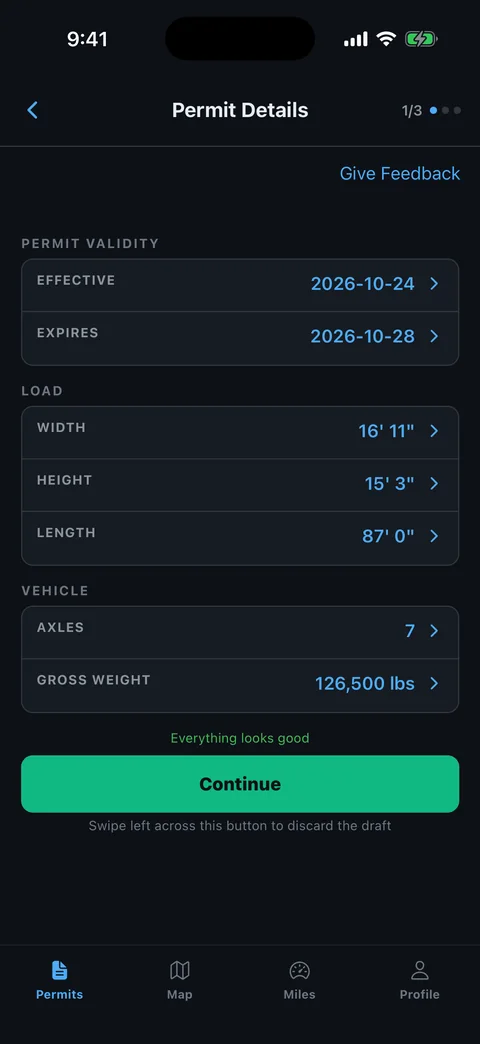
Use the PDF permit to GPS route workflow to read the issued source and review extracted facts before confirmation. Compare every highway, direction, endpoint, and route continuation with the permit and riders. Do not let a plausible shortcut erase a printed road.
Keep the original packet available independently. RouteAll does not issue or amend Caltrans permits, and a navigation line does not replace weekly restrictions or special-condition sheets.
For escort coordination, the pilot-car route-sharing workflow helps the crew discuss the same reviewed path. Read the movement’s conditions together before departure and make sure everyone has the current packet.
Check California’s weekly restrictions again on the day you move, then follow the oversize permit route turn by turn.
The Permit Check In One Minute
A California transportation permit is a packet, not just its first page. Begin with the list of required accompaniments and include every named rider, condition sheet, and map. Compare the approved company, loaded vehicle, dates, dimensions, and weights with the movement you will make. For annual permits, obtain the current weekly short-term restrictions. Check whether an annual-map route needs single-trip authority. Read curfew and special travel conditions for the actual roads, rather than assuming a broad permission covers the whole day. Resolve missing pages or incorrect facts before departure. RouteAll can help read the PDF and review the proposed route, while the complete Caltrans packet remains available to the driver.
Before You Roll
Assemble the complete California packet before checking its route. For annual authority, confirm the current weekly restrictions and required map coverage before entering the affected highway.
Further Reading
Sources And Scope
This guide explains how to read the state’s published permit material. Your issued permit and incorporated conditions govern the move. Check the linked agency material for updates.
- Caltrans Application Forms and Accompaniments — Riders, special conditions and curfew map resources.
- Transportation Permit Conditions, December 2025 — Packet validity, identity and measurement verification, possession and clearance duties.
- Annual Transportation Permittee Responsibilities — Weekly restriction accompaniment and annual-map red-route limitations.