 RouteAll
Indiana Permit Reading Guide
Sources Reviewed: October 23, 2026
Read an Indiana oversize permit with M-204 General Provisions and, when applicable, M-204S Special Provisions. Match the loaded vehicle, final issued route, dates, and operating instructions. Pay particular attention to split trips: a gap across city or county roads needs its own jurisdiction review.
On This Page
Which Indiana Provision Sheets Belong With the Permit?
Collect the issued permit, M-204, and any applicable M-204S before departure. Indiana’s official OSOW page requires the general provision sheet and the special sheet when relevant. A route page alone can miss instructions the driver needs for the movement. Use the links on Indiana’s OSOW page to obtain the official documents.
Confirm that every page is readable in the copy supplied to the driver.
Separate the general rules from movement-specific conditions, then read them together. Mark any referenced slowdown, escort, survey, or district instruction for the crew brief. An attachment called special is not optional simply because most previous loads did not need it.
What Does an Indiana Split Trip Mean?
A split trip breaks state-maintained routing into sections around local-road travel. Indiana explains that it does not hold jurisdiction over city streets or county roads. The split identifies where the truck leaves one state-controlled section and later rejoins another; it does not supply permission for the intervening local road.
Read the Indiana split-trip instructions with the final issued route. Mark the off-system exit and reentry junctions separately.
Ask who controls the connecting road and confirm its approval before movement. A route line that visually joins the sections does not settle that question. The permitted-route planning guide helps make gaps visible before dispatch.
Why Can an Indiana Issued Route Differ From Your Request?
Compare the final issued roads with the route you requested. Indiana’s guidance warns that via points may not remain when an application is processed by the permitting team and the system revalidates the route. A remembered request is therefore not a reliable driving instruction.
Consult the Indiana via-point guidance and read the approved sequence after issuance. If a necessary road or access point is absent, resolve the difference through the official process.
Keep the requested route in office notes only for comparison. Give the driver the final current authority. During review, trace every transition and preserve repeated roads rather than assuming the main highway makes the two versions equivalent.
Which Indiana Load and Vehicle Details Need Matching?
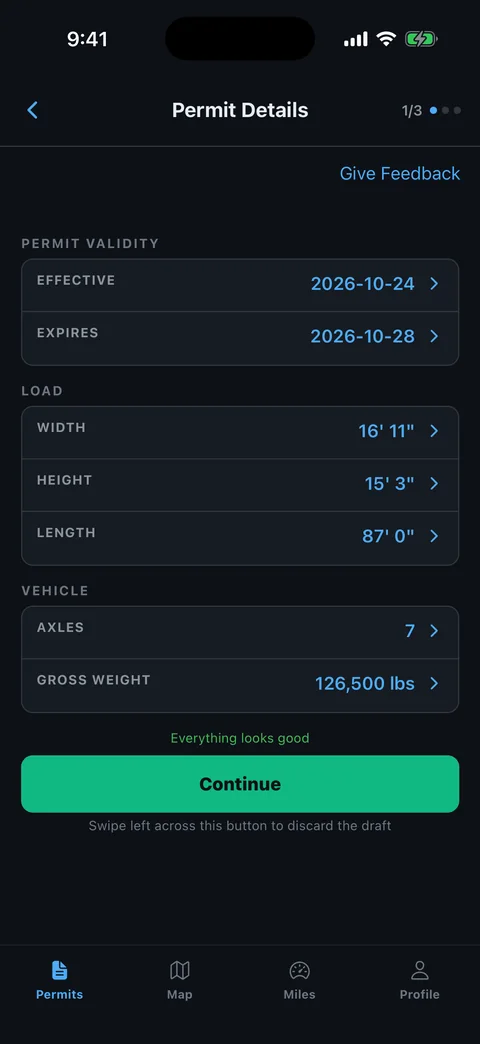
Compare the actual loaded configuration with the permit before considering its route complete. Check vehicle identity, load description, overall dimensions, projections, gross and axle information, and any special equipment reference. For a crated item, distinguish the object inside from the complete transported package.
A measurement from the equipment brochure may omit packaging or trailer effects. If the load or transport position changes, identify every field affected rather than updating a single total.
- Vehicle: Confirm the hauling unit and trailer.
- Load: Match the actual item and transport position.
- Dimensions: Include the complete loaded combination.
- Weight: Preserve the configuration and separate entries.
The permit-errors guide provides a practical comparison method.
How Do You Read Indiana Bridge and Slowdown Instructions?
Read every movement-specific bridge condition before reaching the structure. M-204S includes instructions addressing weight-restricted movements, bridge crossings, escorts, and slowdowns. These actions need planning with the crew; they cannot be reduced to an ordinary map maneuver. Use the M-204S Special Provisions and the exact instructions issued for your load.
Identify the structure, lane or position instruction, movement speed, and coordination where specified.
Make a segment checklist for these tasks. Ask the responsible office or authorized escort to resolve an unclear condition before the truck approaches it. The pilot-car duties guide helps the crew discuss responsibilities without changing Indiana’s issued requirement.
Which Indiana Travel Window and Escort Conditions Apply?
Match the loaded dimensions and permit category to the applicable operating instructions. M-204 separates hours of operation by movement characteristics, while M-204S can add special escort and time requirements. A general continuous-travel statement cannot be applied to every Indiana load.
Read M-204 General Provisions with any special conditions. Confirm dates, allowed hours, required escorts, and meeting arrangements before setting the schedule.
Plan where the crew can hold before a restricted window. If the route uses a local section or a special bridge condition, include those tasks in the timing discussion too. The travel-time guide helps organize a multi-state schedule.
Does the Indiana Document Cover the Return Movement?
Check return scope explicitly. Indiana’s OSOW guidance distinguishes permitted in-state returns from border-crossing cases. Do not infer a return or second loaded movement simply because the original route ends at the place where the next trip starts. Read the Indiana return-route guidance and the issued document.
If the vehicle, route, dates, or return plan is wrong, take the specific issue to Motor Carrier Services or your ordering service.
Ask what official correction or replacement is required. A new map route cannot amend Indiana’s authority. After receiving the result, compare the full packet, including split sections and special provisions, and replace obsolete crew copies.
How Can RouteAll Help Review the Indiana Route?
The PDF permit to GPS workflow explains RouteAll’s extraction and required review. Use the final issued PDF and compare its route, directions, split-trip endpoints, and loaded facts before confirming navigation. Keep M-204, applicable M-204S, and local-road approvals available independently. RouteAll does not issue or amend Indiana permits.
Resolve a proposed line that silently joins an unauthorized local gap or skips a printed road before accepting the route.
An Indiana issued route can differ from the one you requested, so follow the oversize permit route turn by turn as issued, not as planned.
The Permit Check In One Minute
An Indiana permit review starts with the complete packet: the permit, M-204, and M-204S when applicable. Match the loaded vehicle and compare the final issued route with the request. Via points can change during state processing, so a requested path is not the driving authority. A split trip separates state-road sections around local travel; check permission for that gap. Read bridge slowdowns, escort instructions, and operating hours before briefing the crew. Confirm any return movement separately. Resolve incorrect facts through Motor Carrier Services before departure. RouteAll can help read the issued PDF and review a proposed route, but it cannot replace the provision sheets or amend the permit.
Before You Roll
Compare Indiana’s final issued roads and split-trip boundaries before departure. Read special bridge, escort, and time conditions with M-204 and M-204S, then resolve any mismatch through the official process.
Further Reading
Sources And Scope
This guide explains how to read the state’s published permit material. Your issued permit and incorporated conditions govern the move. Check the linked agency material for updates.
- Indiana DOR OSOW — Packet requirements, split trips, via-point changes, return scope and official system.
- M-204 General Provisions — Operating hours, general escort and movement instructions.
- M-204S Special Provisions — Movement-specific bridge, slowdown, escort and coordination framework.