 RouteAll
Illinois Permit Reading Guide
Sources Reviewed: October 23, 2026
Read an Illinois oversize permit with OPER 993 Special Vehicle Movement Permit Provisions. Match the vehicle and load, follow the assigned route, and identify every condition referenced on the permit face. Check separate permission for local roads, toll roads, and toll structures before treating the path as complete.
On This Page
Why Is OPER 993 Part of Your Illinois Permit?
Read the issued permit and OPER 993 together. IDOT’s compliance page requires the provision document to accompany the movement. The permit face may be short because its referenced provisions carry essential operating instructions. Obtain the official edition through IDOT Permit Type and Compliance.
Confirm that both documents are readable and available to the driver before departure.
Do not keep OPER 993 only in an office folder while the truck carries a face-sheet screenshot. Organize the packet so the driver can locate the permit’s named conditions quickly. A document available in principle is less useful when its small print or relevant page cannot be found at the point of use.
How Do Illinois Provisions A, B, and C Fit Together?
Read the detailed permit-face instructions first, then the applicable provision categories. OPER 993 describes a precedence order: the detailed short-form condition, Provision C, Provision B, then Provision A. This prevents a broad general statement from overriding a more specific movement instruction.
The OPER 993 general provisions explain this structure. Identify every code or reference on your permit before choosing which paragraphs to brief.
On a working checklist, copy the reference and write its practical action beside it. Keep the original available for comparison. If two instructions still appear inconsistent, contact IDOT rather than choosing the easier one. The oversize terms glossary can help with vocabulary, but cannot decide a permit conflict.
Does an Illinois Permit Cover the Tollway or Local Streets?
Check separate authority for every road outside IDOT’s state jurisdiction. IDOT explicitly distinguishes municipal, township, county, Skyway, and Illinois Toll Authority roads and structures. The fact that a route connects directly to a state highway does not merge their permitting responsibilities.
Read the jurisdiction notice on IDOT’s application guidance. Mark the boundary where the truck leaves the state roadway and identify the appropriate permission for the next section.
- State segment: Follow the issued IDOT sequence.
- Toll connection: Confirm the relevant authority before entry.
- Local approach: Check the actual road to the site entrance.
- Border crossing: Compare the adjoining state’s route and any separate structure approval.
Which Illinois Equipment and Axle Facts Need Comparison?
Compare the permit with the loaded vehicle, not just the object being hauled. IDOT’s application guidance distinguishes a load on a trailer, an object towed on its own wheelbase, and equipment moving under its own power. Its overweight information includes gross weight, axle weights, and axle spacing.
Use the IDOT application checklist to understand those distinctions. Match the actual method of movement and equipment before relying on the route.
If a trailer or transport position has changed, identify every affected field. Do not assume the same total weight makes the original configuration equivalent. The common permit-errors guide explains how to describe a discrepancy precisely for correction.
How Do You Read the Assigned Illinois Route?
Trace the assigned road list in order and preserve directions and junctions. OPER 993 contains specific provisions about route use and limited access for certain purposes. Do not turn a conditional allowance into broad freedom to choose a convenient road or stop.
Read the applicable assigned-route language in OPER 993 with the conditions on your own permit. Resolve any intended departure from that sequence before planning it as part of the trip.
Make a transition list that includes the entry road, connectors, repeated roads, and final approach. The permitted-route planning guide helps compare the printed sequence with a proposed navigation line without erasing short segments.
How Should You Read Illinois Escort and Bridge Conditions?
Read the applicable escort provisions and the movement’s specific references together. OPER 993 separates general rules, oversize provisions, and special conditions that can address escort arrangements or bridge operation. A condition about one bridge may require a different crew action from ordinary highway travel.
Use OPER 993’s applicable provisions and the exact references printed on your permit. Identify location, escort position, coordination, and movement time before briefing the crew.
Write those actions by segment. Do not infer that a generic pilot-car booking satisfies a special bridge instruction. The pilot-car responsibilities guide provides briefing questions, while the Illinois document supplies the actual requirement.
What Should You Do When an Illinois Permit Is Incorrect?
Contact IDOT before starting when the permit does not cover the movement or contains an error. OPER 993 states this directly. A driver’s acceptance of a familiar route is not a substitute for resolving a wrong vehicle, measurement, date, or condition.
Use the contact on IDOT’s compliance page or the appropriate ordering channel. Describe the printed field, correct fact, and the movement involved. Ask what official correction or replacement is needed.
- Record the mismatch: Be specific about the field or segment.
- Obtain official action: Do not edit the source yourself.
- Review the replacement: Compare the road list and referenced provisions again.
- Replace crew copies: Keep one current working packet.
How Can You Review an Illinois PDF in RouteAll?
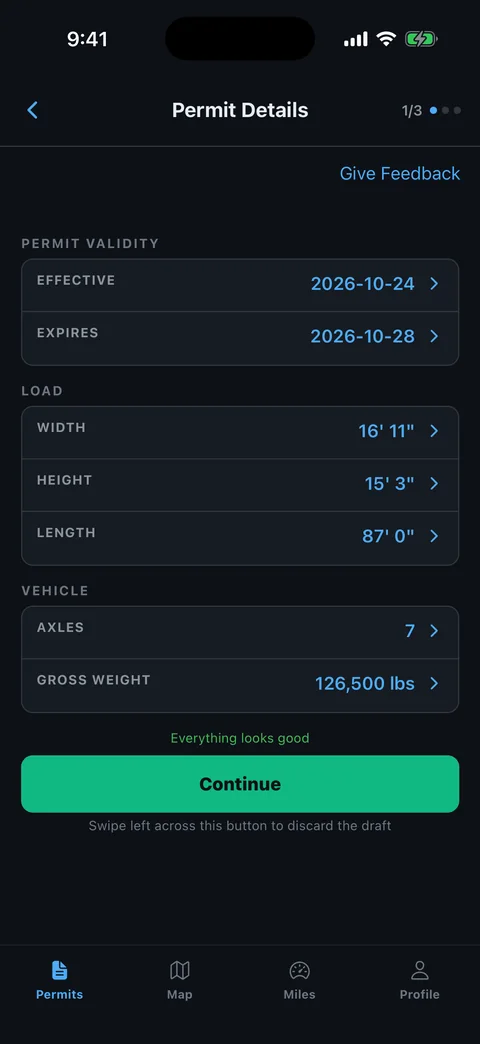
Use the permit PDF to GPS route workflow with the complete issued source. RouteAll reads the document and requires review before confirmation. Compare Illinois roads, directions, endpoints, and configuration facts against the permit. Keep OPER 993 and separate local or toll authority available.
RouteAll does not issue or amend Illinois permits. Resolve any missing connector or unexpected shortcut before accepting the proposed line, and retain the source conditions for the driver and escort crew.
Check whether the Illinois permit covers the Tollway or local streets, then follow the assigned route turn by turn.
The Permit Check In One Minute
An Illinois permit must be read with OPER 993. Start with the specific conditions on the permit face, then the referenced provision categories in their stated order. Match the actual loaded vehicle and axle configuration. Trace the assigned roads through every junction and check separate local or toll-road authority. Read escort and bridge-operation instructions by segment before briefing the crew. If the permit is wrong or does not cover the movement, contact IDOT before starting. Keep readable printed or electronic documents available with the truck. RouteAll can help read the PDF and review a proposed navigation route, but it cannot replace OPER 993, separate permissions, or an official correction.
Before You Roll
Read the permit face and applicable OPER 993 provisions together before the Illinois move. Confirm toll and local-road authority separately, and resolve incorrect facts with IDOT before departure.
Further Reading
Sources And Scope
This guide explains how to read the state’s published permit material. Your issued permit and incorporated conditions govern the move. Check the linked agency material for updates.
- IDOT Permit Type and Compliance — Required OPER 993 accompaniment, accepted format, jurisdiction and contact.
- IDOT Apply — Movement methods, axle and identity fields, local/toll distinctions and ITAP.
- OPER 993 Special Vehicle Movement Permit Provisions, August 2024 — Precedence, assigned-route framework, escort and special conditions, pre-movement error correction.